Federal Church Arson Hate Crime Investigation: Understanding the ATF’s Role and Hate Crime Motivation
A disturbing rise in church arsons has prompted federal agents to examine whether fires at houses of worship stem from bias, turning routine arson probes into hate crime investigations. This analysis clarifies how church arson is defined as a hate crime, outlines the ATF’s specialized forensic methods, explains the Justice Department’s prosecution framework, details the 1996 Church Arson Prevention Act and National Church Arson Task Force coordination, maps the investigative process from scene to courtroom, and highlights community impacts and prevention strategies. By breaking down each element—from legal definitions and evidentiary requirements to inter-agency collaboration and support resources—this article equips readers with a comprehensive understanding of federal responses to religious property attacks.
What Defines Church Arson as a Hate Crime?
Church arson qualifies as a hate crime when investigators establish that setting fire to religious property was motivated by hostility toward the congregation’s faith, elevating the offense from mere property destruction to a federal civil rights violation that carries enhanced penalties and protective measures.
What Constitutes a Hate Crime in Church Arson Cases?
A hate crime involves a criminal act driven by bias against a protected characteristic, such as religion, race or ethnicity. In church arson cases investigators must:
- Identify the target’s religious character.
- Demonstrate bias motivation through statements or symbols.
- Link prejudice to the act of arson.
Evidence of bias can include graffiti with derogatory slurs, social media posts praising the fire, or manifestos that single out a faith community. Establishing bias ensures federal resources and civil rights enforcement apply to the investigation.
How Is Arson Against Religious Property Legally Defined?
Arson is the willful and malicious burning or attempt to burn a structure. When the property is a church or other house of worship, federal statutes classify it as damage to religious property. This classification triggers specific statutes—such as 18 U.S.C. § 247—that define the burning of any building used for “religious exercise” as punishable beyond ordinary state arson laws.
How Do Investigators Prove Hate Crime Motivation in Church Fires?
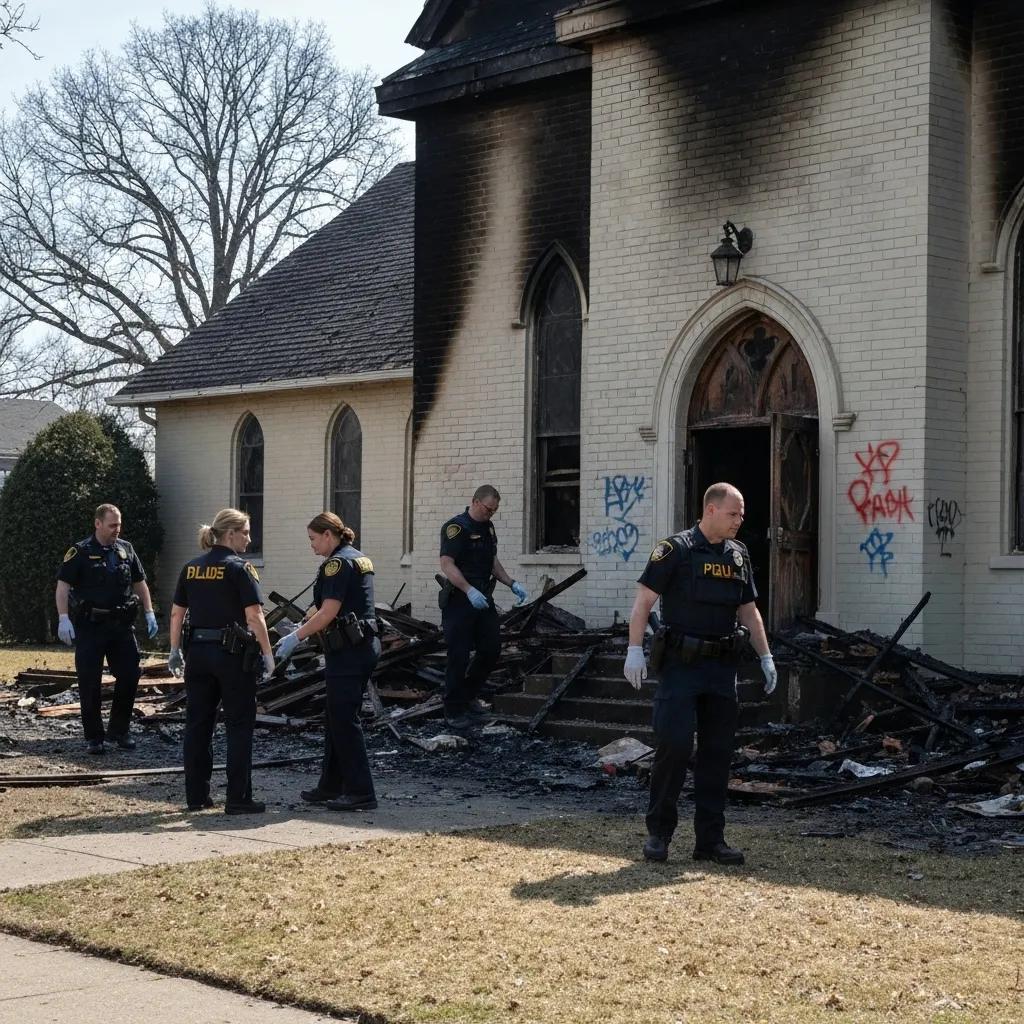
Investigators prove bias motivation by collecting a variety of evidence types that connect the arsonist’s intent to prejudice:
- Physical Evidence: Hate symbols, flyers, stained-glass fragments arranged to convey animus.
- Digital Evidence: Online posts, messages or video recordings expressing hostility.
- Witness Testimony: Statements from neighbors or congregants noting threats or slurs.
- Perpetrator Admission: Confessions, manifestos or interviews revealing religious animus.
By building a mosaic of bias indicators, law enforcement shifts the charge from arson alone to a civil rights violation, unlocking federal investigative and prosecutorial tools.
What Is the ATF’s Role in Investigating Church Arson Hate Crimes?
The Bureau of Alcohol, Tobacco, Firearms and Explosives (ATF) leads technical fire investigation, applies forensic science to determine origin and cause, and collaborates with federal partners to identify bias motivations when a church fire suggests hate crime elements.
How Does the ATF Conduct Fire and Arson Investigations?
ATF fire investigators apply a systematic, science-based protocol that includes:
- Securing and mapping the scene to preserve evidence.
- Identifying burn patterns to locate the point of origin.
- Collecting debris for laboratory accelerant analysis.
- Conducting interviews with witnesses and first responders.
This method ensures that every step—from scene preservation to laboratory reporting—yields reliable data that ties fire behavior to human action, a critical link in hate crime investigations.
What Specialized Resources Does the ATF Use in Church Arson Cases?
Before analyzing results, ATF deploys specialized assets that enhance bias investigations:
These resources accelerate the evidentiary process, allowing investigators to focus on motive analysis and inter-agency coordination without compromising scientific rigor.
How Does the ATF Collaborate with Other Federal Agencies?
ATF works alongside the FBI and DOJ by:
- Sharing forensic findings with the FBI’s civil rights division for bias assessment.
- Providing technical support to federal prosecutors.
- Participating in joint task forces that pool intelligence, operational planning and legal strategies.
This collaboration ensures that every arson case with hate crime indicators receives both scientific precision and prosecutorial oversight.
How Does the Justice Department Prosecute Church Arson as a Hate Crime?
The Justice Department enforces federal statutes by bringing charges under civil rights laws, presenting bias evidence in court and seeking enhanced sentences that reflect the severity of religiously motivated violence.
What Is the Role of the DOJ’s Civil Rights Division in These Cases?
The Civil Rights Division evaluates evidence of bias, oversees grand jury presentations, and guides U.S. Attorneys in framing charges under statutes such as 18 U.S.C. § 247. By supervising prosecutorial strategy and ensuring compliance with hate crime legislation, the division guarantees that religiously targeted violence is addressed as a civil rights violation.
Which Federal Statutes Govern Church Arson Hate Crime Prosecutions?
The primary statute is 18 U.S.C. § 247, which makes it a federal offense to intentionally damage religious property because of the owner’s religious character. Other relevant statutes include:
- 18 U.S.C. § 2 (aiding and abetting hate crimes)
- 18 U.S.C. § 371 (conspiracy to commit civil rights offenses)
These laws provide the framework for charging individuals whose actions transcend simple property damage and threaten constitutional protections.
What Are the Legal Penalties for Church Arson Under Federal Law?
The Church Arson Prevention Act of 1996 sets mandatory sentencing enhancements for arsons motivated by religious bias:
Enhanced penalties underscore the federal commitment to safeguarding religious freedom and deterring hate-inspired violence.
What Is the Church Arson Prevention Act of 1996 and How Does It Impact Investigations?
Enacted in response to a surge in church burnings, the Church Arson Prevention Act of 1996 strengthened federal authority to investigate and punish arsons against houses of worship, creating specialized task forces and expanding civil rights enforcement.
What Led to the Creation of the Church Arson Prevention Act?
A dramatic increase in attacks on religious properties during the early 1990s revealed gaps in federal jurisdiction and penalties. Lawmakers responded by directing the DOJ and ATF to coordinate efforts and allocate resources specifically for church arson investigations under civil rights statutes.
What Are the Key Provisions and Penalties of the Act?
The Act introduced several critical measures:
These provisions ensure a unified federal approach from investigation through prosecution.
How Does the Act Support Federal Investigations and Prosecutions?
By creating the National Church Arson Task Force and mandating data sharing, the Act fosters real-time coordination among ATF, FBI and U.S. Attorneys, streamlining evidence transfer, legal review and community outreach while preserving the integrity of bias investigations.
What Is the National Church Arson Task Force and How Does It Coordinate Investigations?

The National Church Arson Task Force (NCATF) unites federal, state and local agencies to pool forensic expertise, share intelligence and maximize arrest and conviction rates in religiously motivated arson cases.
Which Agencies Are Part of the National Church Arson Task Force?
Joint operations align investigative efforts, ensuring that no jurisdictional boundary impedes bias crime enforcement.
How Does the Task Force Improve Investigation and Arrest Rates?
By synchronizing case assignments, sharing forensic and intelligence data, and conducting coordinated raids and arrests, the task force reduces duplicative effort and accelerates offender identification, leading to higher rates of prosecution and detention.
What Are Notable Achievements of the Task Force?
Since its inception, NCATF has:
- Coordinated over 827 investigations of church arsons.
- Achieved convictions in more than 35 percent of federal cases.
- Provided community outreach programs that raised awareness and improved reporting.
These outcomes reflect the task force’s effectiveness in dismantling bias-motivated arson networks and restoring a sense of safety in religious communities.
How Does the Investigative Process Unfold from Crime Scene to Courtroom?
A hate crime arson investigation progresses through carefully sequenced steps—from immediate scene response and evidence collection to building a bias-driven case and securing convictions under federal civil rights statutes.
What Are the Initial Steps in Responding to a Church Arson?
First responders and ATF agents secure the scene, document structural damage, photograph fire-pattern evidence and collect debris for lab analysis. Preserving fragile indicators of accelerants and bias symbols is critical before investigators move to motive assessment.
How Is Hate Crime Motivation Established During Investigation?
After forensic origin-and-cause analysis, investigators interview congregants and neighbors to identify threats or bias statements, cross-reference digital activity for hate-filled communications and compare patterns with known extremist behaviors. These components converge to form a comprehensive motive narrative.
What Happens During Prosecution and Sentencing?
The DOJ’s Civil Rights Division presents bias evidence to a grand jury, secures indictments under 18 U.S.C. § 247 and related statutes, and pursues trial with forensic fire data, witness testimony and digital communications. Sentencing incorporates the Act’s enhancements, ensuring penalties reflect both property destruction and civil rights violations.
What Is the Impact of Church Arson Hate Crimes on Communities and How Are They Prevented?
Hate-motivated church arson inflicts deep emotional trauma on worshippers, erodes community cohesion and violates constitutional religious freedom, prompting proactive prevention measures and federal–local partnerships to safeguard houses of worship.
How Do Church Arsons Affect Religious Communities Emotionally and Socially?
Burned sanctuaries shatter congregants’ sense of security, provoke fear of further attacks, disrupt services and community programs, and demand costly rebuilding efforts—all of which can leave lasting psychological scars and social fragmentation.
What Prevention Strategies and Resources Are Available to Protect Churches?
Communities employ layered security measures to deter arson and hate crimes:
- Install exterior lighting and motion sensors to reduce concealment opportunities.
- Engage neighborhood watch programs that report suspicious activity.
- Conduct fire prevention training and drills for staff and volunteers.
- Develop rapid reporting protocols to alert law enforcement of threats.
Proactive defenses strengthen resilience by combining technological safeguards with community vigilance.
How Can Local and Federal Agencies Support Community Resilience?
Federal–local partnerships provide training workshops, grant funding for security upgrades, and outreach campaigns that educate congregations on recognizing bias indicators. This collaborative approach reinforces communal unity, empowers reporting and reduces hate crime recurrence.
Four decades after enacting the Church Arson Prevention Act and establishing task forces, federal agencies remain committed to protecting religious freedom through rigorous technical investigations, bias-focused prosecutions and community partnerships that deter hate-motivated violence.