Cybersecurity Innovation in 2025: Key Trends, Solutions, and Impact
Cybersecurity innovation in 2025 centers on how organizations detect, contain, and recover from increasingly automated and persistent threats while preparing for future paradigm shifts such as quantum computing. Readers will learn how advances in artificial intelligence, zero trust architecture, cloud security, quantum-resistant cryptography, threat intelligence, and ransomware defense change defensive postures and practical outcomes for businesses and citizens. Many organizations struggle with blurred perimeters, limited visibility across multi-cloud estates, and adversaries using generative AI to scale attacks; addressing these requires both technical controls and process-level changes. This article maps core trends, practical solutions, and measurable strategies that security teams and technology leaders can apply now to reduce risk and improve resilience. We will examine the latest macro trends, detail how AI improves detection and response, explain Zero Trust implementation, unpack threat intelligence platforms, compare cloud security tooling, outline post-quantum readiness, and produce an actionable ransomware playbook tailored to Pakistan and South Asia. ARY News’ mission is: To provide timely and comprehensive news and current affairs coverage, keeping the audience informed and engaged with diverse content.
What Are the Latest Trends in Cybersecurity Innovation for 2025?
Cybersecurity innovation in 2025 is defined by the convergence of AI-driven detection, Zero Trust principles, cloud-native controls, early post-quantum planning, and the evolution of ransomware and supply-chain threats. These trends arise because cloud adoption, remote work, and commoditized attack tooling continue to erode traditional perimeters, forcing organizations to adopt behavioral analytics, micro-segmentation, and cryptographic agility. The practical benefit is faster detection, reduced lateral movement, and a clearer migration path toward quantum-safe systems that protect long-lived secrets. Below is a concise list of the top trends optimized for quick reference and featured snippets.
Top 2025 trends in cybersecurity innovation:
- AI-Powered Detection and Response: Machine learning identifies anomalous telemetry and automates containment.
- Zero Trust Architecture: Continuous verification and least-privilege access reduce lateral risk.
- Cloud-Native Security and CASB Adoption: Controls focus on data access, posture management, and multi-cloud visibility.
- Quantum-Resistant Cryptography: Migration planning for post-quantum algorithms begins for critical assets.
- Ransomware 3.0 & Supply Chain Risks: Attackers target backups, APIs, and third-party services for maximum disruption.
To summarize major trend entities and their 2025 impact, the table below provides a quick EAV-style snapshot for rapid scanning.
This table summarizes key trend entities, attributes, and 2025 impact examples.
This summary shows how entities map to concrete 2025 impacts and offers a rapid reference for security planning. ARY News will continue to monitor these trends as part of its coverage: To provide timely and comprehensive news and current affairs coverage, keeping the audience informed and engaged with diverse content.
How Is Artificial Intelligence Transforming Cybersecurity?

Artificial Intelligence transforms cybersecurity by automating detection, enriching telemetry, and enabling predictive prioritization of high-risk events. Machine learning models analyze behavioral baselines and surface deviations in user, endpoint, and network telemetry, allowing teams to prioritize true positives faster and reduce mean time to detect. Practical applications include EDR/XDR systems that correlate cross-domain signals and SOAR platforms that trigger playbooks for containment and remediation. While powerful, these systems require high-quality training data and human oversight to avoid model drift or adversarial manipulation; the next paragraph describes the Zero Trust drivers that make AI outputs more actionable.
Adversarial AI in Cybersecurity: Defending Against Evolving AI-Powered Threats
The swift incorporation of Artificial Intelligence (AI) into cyber security makes a difference in digital defense systems, enabling automatic threat detection, real-time anomaly detection, and predictive analysis. Cybercriminals turned to adversarial AI approaches for developing AI weapons to compromise, evade or deceive AIbased security models. They include maliciously constructed inputs or manipulation techniques exploiting vulnerabilities of machine learning algorithms, allowing an attacker to bypass the security mechanisms, stealthily execute cyber attacks, and even corrupt AI-driven decision-making systems, among others. That makes a fierce competition for the organization to maintain robust security infrastructures within the growing arms race AI-versus-AI. This research attempts to examine how adversarial AI threats evolve and their influences on cyber security and the most effective techniques of defense against them. The research classifies the adversarial AI threat into five main types: evasion attacks, poisoning attacks, model inversion, AI-generated phishing, and adversarial malware, demonstrating their real-world instances through such studies as Deep Locker, adversarial deep fakes, and self-learning ransom ware. A mixedmethod approach involved a survey of 300 cyber security professionals regarding their level of awareness of such threats and the efficacy of the defense mechanisms, namely, adversarial training, AI-enhanced intrusion detection systems, and anomaly detection algorithms.
Adversarial AI and cybersecurity: defending against AI-powered cyber threats, SA Syed, 2025
AI-powered detection integrates with Zero Trust controls to enforce context-aware policies and automate policy decisions in real time.
Why Is Zero Trust Architecture Becoming Essential for Security?
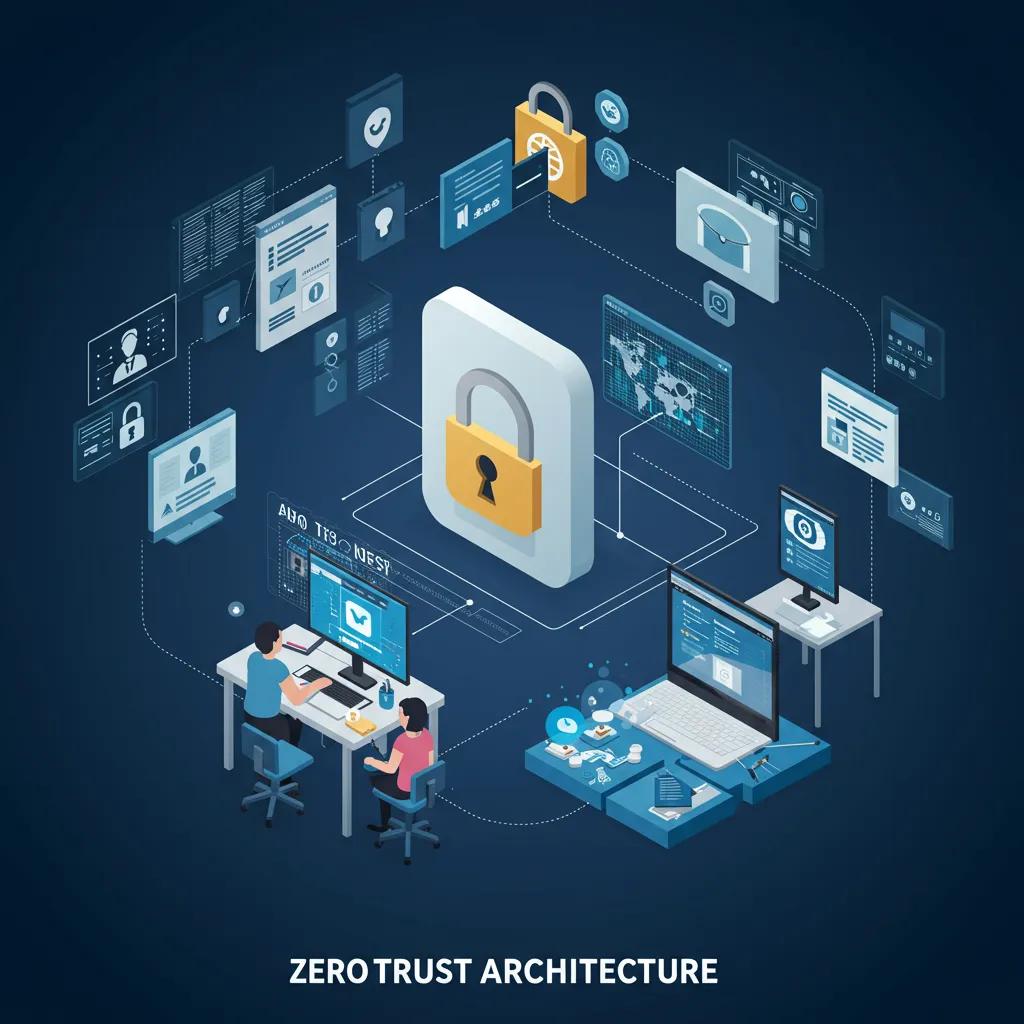
Zero Trust Architecture is essential because perimeters have dissolved and access decisions must be continuous and contextual rather than binary. The ZTA mechanism relies on identity verification, device posture checks, and micro-segmentation to enforce least-privilege access and minimize lateral movement after compromise. Organizations implementing ZTA see clearer segmentation of high-value assets and fewer broad trust relationships that attackers can exploit. Adoption challenges include legacy systems, integration complexity, and operational overhead, which the next section addresses with practical cloud security advances.
Implementing Zero Trust often begins with identity upgrades and micro-segmentation work that set the stage for cloud-native enforcement.
What Advances Are Driving Cloud Security Solutions?
Cloud security is advancing through CASB adoption, posture management automation, and improved encryption controls that help organizations manage data access across multiple providers. CASBs mediate cloud app use and apply policies to prevent data exfiltration, while cloud posture management tools provide continuous compliance checks and automated remediation to reduce misconfiguration risk. Encryption improvements, including customer-managed keys and better key lifecycle management, address data sovereignty and regulatory concerns in regional markets. These developments make cloud security more automated and policy-driven, and the next subsection explores quantum-resistant cryptography as the next preparatory frontier.
Modern cloud controls increasingly integrate with identity and device posture to deliver end-to-end policy enforcement.
How Is Quantum-Resistant Cryptography Preparing for Future Threats?
Quantum-resistant cryptography prepares organizations by encouraging inventory of cryptographic assets and the design of cryptographic agility to swap algorithms when standards mature. Post-quantum algorithms—such as certain lattice-based and code-based candidates—are being evaluated for performance and interoperability, and organizations are piloting hybrid schemes to protect long-lived secrets. The key mechanism is cryptographic agility: modular crypto stacks and key management systems that allow algorithm replacement without widespread code changes. Planning now reduces future re-encryption costs and protects archived data that may remain valuable to adversaries in a quantum era.
Cryptographic agility paired with a prioritized inventory enables safe pilot migrations and hybrid deployments.
What Are Emerging Challenges in Supply Chain and Ransomware Security?
Supply chain and ransomware threats are evolving; attackers employ targeted API abuse and focus on backup systems or managed service providers to maximize impact. The mechanism includes supply-chain compromise via third-party updates or abused continuous integration pipelines and ransomware gangs using credential harvesting to access backups and cloud APIs for destructive operations. Mitigations include SBOM maintenance, stronger vendor risk assessments, and immutable or air-gapped backups combined with robust API security controls. These combined tactics reduce exposure to both systemic supply-chain incidents and the newer ransomware patterns emphasized earlier.
Effective defense combines SBOMs, vendor controls, and technical protections like immutable backups to reduce systemic risk.
How Does AI Enhance Cybersecurity Detection and Defense?
AI enhances cybersecurity by ingesting vast telemetry, identifying patterns adversaries miss, and automating repetitive containment tasks so human analysts focus on complex investigations. The mechanism includes supervised models that detect known IOC patterns and unsupervised anomaly detectors that surface unusual behaviors, which feed into SOAR playbooks for automated response. Benefits are faster triage, reduced analyst fatigue, and improved detection across endpoints and cloud services, while limitations include false positives, model bias, and the need for curated training sets. The following list summarizes core AI roles for clear operational adoption.
- Detection: ML models identify anomalies and known IOCs across telemetry.
- Automation: SOAR and automated playbooks reduce manual steps for containment.
- Predictive Analysis: Risk scoring and trend forecasting prioritize scarce resources.
These roles form a pipeline from detection through response that shortens dwell time and improves outcomes. Next, we look at concrete systems that implement these capabilities.
What Are AI-Powered Threat Detection and Automated Response Systems?
AI-powered threat detection systems, such as EDR and XDR platforms, ingest endpoint, network, and cloud telemetry and apply models to identify malicious behavior patterns and escalate high-confidence alerts. The mechanism couples telemetry enrichment, threat correlation, and risk scoring to present an actionable incident view and often integrates with SOAR to execute containment playbooks such as isolating endpoints or revoking credentials. Examples include automated IOC blocking, workflow-driven investigations, and API-based orchestration that reduces mean time to contain. The main limitation lies in data quality—poor telemetry leads to noisy models—so organizations must invest in telemetry pipelines and model validation.
High-quality telemetry and human oversight ensure AI-driven actions are effective and proportionate.
How Does AI Combat Deepfake Phishing and Generative AI Risks?
AI combats deepfake phishing by applying cross-modal detection, forensic signal analysis, and behavioral context to validate content authenticity and flag manipulative media. Detection signals include subtle artifacts in audio/video encoding, inconsistencies in lip-sync, and anomalous metadata combined with sender behavior analysis; these signals feed ML classifiers to reduce successful social-engineering attacks. User education and verification protocols remain vital because technology is not perfect; combining automated detection with human checks increases resilience.
A layered approach—technical detection plus process controls—reduces the effectiveness of generative-AI-enabled scams.
What Are the Benefits and Limitations of AI in Cybersecurity?
AI delivers scale, speed, and pattern recognition that human analysts cannot match, improving detection rates and enabling automated containment that reduces damage. The mechanisms include model-based anomaly detection, enrichment with threat intelligence, and automated playbooks that act on validated signals. Limitations include adversarial attacks on models, false positives that erode trust, and the need for ongoing model maintenance and skilled staff to interpret outputs.
Balancing automation with human judgment ensures AI amplifies defender capabilities without introducing new systemic risks.
What Is Zero Trust Architecture and How Does It Improve Network Security?
Zero Trust Architecture improves network security by eliminating implicit trust and requiring continuous verification of identity, device posture, and context before granting access to resources. The mechanism replaces flat trust zones with micro-segmentation, role-based least-privilege policies, and continuous authentication to limit attack surfaces and contain breaches. Benefits include reduced lateral movement, improved auditability, and better alignment with cloud and hybrid environments where traditional perimeters are ineffective. Implementation requires careful inventory, identity upgrades, and phased enforcement to manage complexity and integration costs.
A phased roadmap reduces disruption while delivering incremental security gains that compound over time.
What Are the Principles of “Never Trust, Always Verify”?
“Never trust, always verify” rests on three core principles: least-privilege access, continuous authentication and authorization, and micro-segmentation to isolate workloads and reduce lateral risk. Least-privilege limits user and service rights to necessary capabilities; continuous authentication re-evaluates trust based on real-time signals like device posture and location; micro-segmentation enforces granular network and workload boundaries to contain compromise. These principles together shift security from static perimeter controls to dynamic, context-aware enforcement that better fits cloud-native environments. The next subsection explains implementation steps for organizations.
Adhering to these principles requires updates across identity, device management, and network policy systems.
How Is Zero Trust Implemented in Modern Organizations?
Implementation typically follows a phased roadmap: assess and inventory assets, segment critical resources, enforce identity and access controls, and continuously monitor and adapt policies. Practical steps include deploying strong identity and access management, implementing device posture checks, applying micro-segmentation to critical workloads, and integrating policy enforcement with telemetry and analytics. Organizations often begin with high-value asset protection and expand controls iteratively to manage cost and complexity. Tooling choices should prioritize interoperability, API integrations, and support for hybrid and cloud-native workloads.
A stepwise approach balances security gains with operational feasibility and measurable ROI.
What Are the Benefits and Challenges of Zero Trust Security Models?
Benefits include significant containment improvements after breaches, reduced attack surface, and better compliance reporting; the mechanism for these gains is granular, context-aware policy enforcement that limits privilege escalation. Challenges include integration with legacy systems, increased operational overhead during transition, and the cultural shift required for engineering and business teams to accept tighter controls. Cost/ROI considerations often favor phased deployments that secure critical assets first while delivering measurable reductions in risk. Clear governance and executive sponsorship accelerate adoption and align technical changes with business priorities.
Evaluating benefits and challenges together enables realistic planning and targeted investment in Zero Trust initiatives.
How Are Threat Intelligence Platforms Providing Actionable Cybersecurity Insights?
Threat Intelligence Platforms (TIPs) provide actionable insights by aggregating diverse feeds, normalizing indicators, and correlating threat activities to produce contextual alerts that security teams can operationalize. The mechanism includes ingestion, enrichment, and IOC lifecycle management, combined with APIs that allow TIPs to push relevant signals into EDR/XDR and SOAR systems for automated or analyst-driven response. Value comes from reducing time to detect emerging threats, enabling vendor risk signals for supply-chain defense, and supporting coordinated sharing among peers. The following list highlights the core TIP features that make them effective in practice.
- Data Aggregation and Normalization: Consolidates multiple feeds into a consistent format.
- Threat Enrichment and Correlation: Adds context and connects disparate indicators.
- Integration APIs and Automation: Enables orchestration with EDR, SOAR, and SIEM tools.
These features collectively shorten detection time and enable automated containment workflows. The next subsection breaks down feature specifics.
What Features Define Effective Threat Intelligence Platforms?
Effective TIPs excel at data ingestion from open-source and commercial feeds, normalizing disparate formats, enriching IOCs with context, and providing robust APIs for automation and orchestration. Mechanisms such as reputation scoring, yara/rule management, and closed-loop feedback from incident response improve signal quality and reduce false positives. Integration with orchestration tools enables automated blocking or quarantining when confidence thresholds are met, while analyst workflows allow manual validation for complex events. Strong access controls and localized context make TIPs more useful for region-specific threats and compliance needs.
Automation combined with analyst workflows ensures TIP outputs are both fast and trustworthy.
How Do Threat Intelligence Platforms Support Ransomware and Supply Chain Defense?
TIPs support ransomware defense by distributing early IOCs, highlighting attacker infrastructure, and surfacing vendor compromise signals that indicate supply-chain exposure. The mechanism includes automated IOC sharing to EDR and firewalls, threat actor profiling to anticipate tactics, and SBOM correlation to identify affected components. In supply-chain scenarios, TIPs flag suspicious update routes or third-party anomalies so organizations can isolate dependencies before compromise spreads. These capabilities speed containment, enable proactive patching or vendor coordination, and reduce recovery timelines during incidents.
What Are Best Practices for Leveraging Threat Intelligence in Pakistan and South Asia?
Local organizations should prioritize actionable, locally contextual feeds and establish information-sharing communities to amplify regional relevance and visibility. Practical steps include selecting TIP feeds that cover regional threat actors, balancing open-source intelligence with costed commercial feeds, and creating lightweight sharing agreements between enterprises and sector peers. ARY News provides timely, localized reporting and resources to help practitioners track implementation and policy issues; ARY News’ mission is: To provide timely and comprehensive news and current affairs coverage, keeping the audience informed and engaged with diverse content. Resource-constrained teams can begin with curated feeds and escalate to commercial solutions as maturity grows.
What Are the Best Cloud Security Solutions for Protecting Data and Access?
Best cloud security solutions combine CASB, SWG, EDR/XDR, and cloud posture management to provide layered protection across access, data control, and configuration hygiene. The mechanism pairs policy enforcement at the access layer with continuous posture checks and endpoint detection to catch both misconfigurations and malicious behaviors. For Pakistani businesses, practical benefits include improved regulatory alignment, stronger data control, and reduced risk from remote work and BYOD. The table below compares common solutions, key features, and use cases relevant to regional organizations.
This table helps compare cloud security approaches and recommends use cases for Pakistani businesses.
This comparison clarifies how combining these tools provides defense-in-depth for cloud-native and hybrid environments. Next, we explain CASB and SWG mechanics.
How Do Cloud Access Security Brokers and Secure Web Gateways Work?
CASBs act as a policy enforcement point between users and cloud apps, inspecting activity and applying DLP, encryption, or session controls to prevent data leakage. Secure Web Gateways filter web traffic, enforce acceptable use policies, and block malicious domains before they reach endpoints or cloud services. Mechanistically, both integrate with identity providers and device posture systems to make access decisions based on context such as user role, location, and risk signals. This layered enforcement is especially valuable for companies with remote workforces and multiple cloud services.
Combined with identity controls, CASB and SWG deliver contextual policy enforcement across cloud and web access.
What Are Multi-Cloud Security Challenges and Compliance Requirements?
Multi-cloud environments challenge visibility, IAM consistency, and data residency compliance because providers expose different telemetry and control models. Organizations must centralize telemetry, normalize IAM policies, and map provider-specific controls to a unified governance framework to meet regulatory obligations. Common recommended checks include validating encryption at rest, managing key custody, and ensuring audit trails across providers. Addressing these areas reduces risk from misconfiguration and simplifies compliance reporting in regulated markets.
A unified policy layer and centralized telemetry are core to reducing multi-cloud complexity and maintaining compliance.
How Can Pakistani Businesses Enhance Cloud Security Posture?
Pakistani businesses should prioritize inventory and classification of cloud data, adopt CASB or posture management where feasible, and implement encryption and robust key management for sensitive datasets. Mechanisms include staged deployment of posture scanning, staff training on secure cloud patterns, and integrating EDR/XDR to detect suspicious lateral activity across cloud workloads. Startups and SMEs can use vendor-agnostic checklists to reduce vendor lock-in and focus first on high-impact controls like MFA, encryption, and automated backup validation. These steps deliver immediate resilience gains without prohibitive cost.
A pragmatic, prioritized checklist balances budget constraints with high-impact security improvements.
How Is Quantum-Resistant Cryptography Shaping the Future of Cybersecurity?
Quantum-resistant cryptography shapes the future by forcing organizations to inventory cryptographic dependencies and design systems with agility to adopt post-quantum algorithms when standards stabilize. The mechanism involves pilot implementations of candidate algorithms, hybrid schemes that combine classical and post-quantum primitives, and modern key-management practices that can rotate and replace algorithms with minimal disruption. Benefits include long-term confidentiality of archived data and protection of persistent secrets, while costs are managed through staged pilots and focus on high-risk assets. The next subsection details algorithm families and practical planning.
Cryptographic agility ensures organizations can adapt quickly once standards become final and interoperable.
What Are Quantum-Safe Algorithms and Post-Quantum Encryption?
Quantum-safe algorithms include candidate families such as lattice-based, code-based, and multivariate schemes that resist known quantum attacks on asymmetric cryptography. These algorithms prioritize security against quantum-capable adversaries while balancing performance and interoperability for real-world systems. Current standards work is maturing, and many organizations pilot hybrids that pair classical algorithms with post-quantum candidates to maintain compatibility while reducing future re-encryption needs. Performance testing and interoperability trials help organizations choose suitable candidates for their environment.
Pilot testing and hybrid deployment reduce migration risk while standards are finalized.
Why Is Cryptographic Agility Important for Emerging Threats?
Cryptographic agility is the design principle that allows systems to swap cryptographic algorithms and key types without extensive code or architectural changes. The mechanism includes modular crypto libraries, centralized key management, and versioned protocols that permit phased algorithm replacement. Importance lies in reducing future migration costs and ensuring quick remediation if a specific algorithm becomes vulnerable. Organizations that build agility now can respond to standardization outcomes and emergent threats with minimal service disruption.
Designing for agility today protects against both quantum and classical algorithmic surprises tomorrow.
How Are Organizations Preparing for Quantum Computing Risks?
Organizations prepare by inventorying cryptographic assets, identifying long-lived secrets that require protection, and planning pilot migrations for low-risk systems to test interoperability. Practical steps include classifying data by retention and sensitivity, implementing hybrid encryption where appropriate, and working with vendors to understand their post-quantum roadmaps. These actions create a phased migration plan that focuses resources on assets with the highest quantum exposure. Regular reassessment ensures plans evolve with standards and threat developments.
A prioritized, inventory-driven approach enables efficient allocation of effort and risk mitigation.
What Are Effective Strategies to Combat Ransomware 3.0 and Emerging Cyber Threats?
Effective strategies to combat Ransomware 3.0 combine prevention, detection, and resilient recovery to address attacks that target backups, APIs, and third-party providers. The mechanism includes hardened backup architectures (immutable or air-gapped), API security hygiene, threat intelligence integration for early warning, and automated containment to reduce dwell time. Measurable outcomes include reduced recovery time objectives (RTOs), fewer successful encryptions of backup stores, and shortened mean time to contain. The checklist and table below provide a concise, actionable playbook and metrics for security teams.
Key strategies and expected outcomes are summarized below.
- Harden Backups: Implement immutable snapshots and offline copies to prevent encryption of recovery data.
- Secure APIs: Apply least-privilege, rate limits, and monitoring to prevent abuse of programmatic access.
- Integrate TIPs and Automation: Enrich telemetry with threat intelligence and automate containment via SOAR.
These strategies prioritize both stopping initial compromise and ensuring rapid, verifiable recovery.
This table provides a compact playbook with measurable outcomes.
This playbook links strategic choices to measurable outcomes that security leaders can track. The final subsection breaks down ransomware 3.0 tactics.
How Does Ransomware 3.0 Target Backups and APIs?
Ransomware 3.0 targets backups by discovering backup credentials, exploiting cloud APIs, and encrypting or deleting recovery copies to force payment or prolong downtime. Mechanisms include credential theft, lateral movement to backup orchestration systems, and abuse of service-provider APIs that control snapshots and replication. Recommended mitigations include immutable backups, strict API permissions, MFA for backup consoles, and frequent validation of restore processes. These steps close common attacker routes and ensure integrity of recovery artifacts.
Validating restores periodically ensures backups are reliable and not silently corrupted.
What Role Do Threat Intelligence and Automation Play in Ransomware Defense?
Threat intelligence provides early indicators—such as new ransomware infrastructure or compromised vendor signals—that TIPs feed into detection systems, enabling automated blocking or quarantine actions. Mechanistically, enriched telemetry triggers SOAR playbooks to isolate affected hosts, revoke credentials, and block malicious command-and-control endpoints. Automation reduces manual friction during high-pressure incidents and helps maintain consistent response steps with measurable checkpoints. Coordinated TIP, EDR, and backup controls shorten containment time and improve recovery prospects.
Automated, intelligence-driven orchestration is central to reducing damage from fast-moving ransomware incidents.
What Are Recommended Best Practices for Incident Response and Recovery?
Incident response best practices prioritize containment, evidence preservation, and sequenced recovery: isolate affected systems, preserve logs for forensics, notify stakeholders, validate backup integrity, and restore using the least-risk path. Mechanisms include predefined playbooks, communication templates, and recovery sequencing that prioritizes critical services. KPIs to track include time to isolate, validation pass rates for backups, and time to full service restoration. Readers can follow ARY News for ongoing coverage of incident response developments; ARY News aims To provide timely and comprehensive news and current affairs coverage, keeping the audience informed and engaged with diverse content.
Consistent drills, clear escalation paths, and post-incident reviews complete the response lifecycle and drive continuous improvement.
Conclusion
Cybersecurity innovation in 2025 offers organizations the ability to enhance their defenses against evolving threats through AI-driven detection, Zero Trust architecture, and quantum-resistant cryptography. By adopting these strategies, businesses can significantly improve their resilience, reduce risks, and ensure compliance in an increasingly complex digital landscape. To stay ahead of potential vulnerabilities, it’s essential to implement these solutions proactively and continuously adapt to emerging challenges. Explore our resources to learn more about how to fortify your cybersecurity posture today.