Augmented Reality Technology: Innovations, Market Trends, and Applications in Journalism and Enterprise
Augmented reality (AR) overlays contextual digital content onto the physical world, enabling richer, spatially aware experiences that deepen understanding and engagement across journalism and enterprise workflows. This article explains how AR works at a technical level, contrasts AR with virtual and mixed reality, and maps key device categories, platforms, and development patterns shaping 2025. Readers will learn how AR transforms reporting through immersive storytelling, how AI accelerates AR adoption, what devices and SDKs matter for publishers and developers, and what ethical safeguards are essential for privacy and misinformation risk management. AR presents practical benefits for enterprises—from remote assistance to retail visualization—while also posing data and accessibility challenges that demand design and policy responses. AR is especially relevant to Pakistani audiences and industries, and ARY News is described as a dynamic news platform emphasizing “Ai Reporting Yard” for accurate, fast, and reliable news; that positioning suggests clear editorial opportunities to pilot AR explainers, live overlays, and localized interactive reporting. The following sections unpack technical mechanisms, newsroom applications, device comparisons, market drivers, ethical considerations, future trends, and localized strategies for Pakistan and South Asia.
What Is Augmented Reality and How Does It Differ from Virtual Reality?
Augmented reality (AR) augments physical environments with contextual digital layers, using sensors and real-time rendering to place graphics or data into a user’s view. The mechanism relies on input (cameras, IMUs, depth sensors), spatial processing (SLAM and scene understanding), and low-latency rendering, producing immediate utility such as annotated maps or interactive visualizations. AR’s primary benefit is contextual clarity: it preserves real-world presence while enhancing comprehension through overlays that highlight otherwise invisible relationships. This hybrid interaction model differs sharply from immersive virtual reality, which replaces the physical environment entirely, and from mixed reality, which blends elements of both with higher spatial persistence. Understanding these distinctions helps newsrooms and enterprises choose the right medium for storytelling and task support, which leads into a technical primer on core AR components and how they operate in practice.
How Does Augmented Reality Work?
AR systems start with sensors—cameras, inertial measurement units (IMUs), and occasionally depth or LiDAR sensors—that capture appearance and motion data from the environment. These inputs feed algorithms that perform localization and mapping (SLAM), enabling the device to track its position and build a spatial map where virtual content can be anchored. Computer vision models then identify planes, objects, and semantic features in the scene, allowing overlays to align correctly and behave consistently as the user moves. Finally, rendering pipelines composite graphics or 3D assets into the view with attention to latency and occlusion, since perceptual mismatches degrade the sense of realism. Engineers optimize for low-latency pipelines and efficient on-device inference to preserve interactivity, and these technical constraints inform which AR experiences are practical on phones versus headsets.
What Are the Key Differences Between AR, VR, and Mixed Reality?
AR maintains the user’s connection to the physical environment and adds digital context, while VR immerses the user in a wholly simulated environment that blocks real-world sensory input. Mixed reality (MR) sits between these poles by aiming for more persistent, spatially aware virtual objects that can interact believably with real surfaces and users. Hardware differences follow: AR often runs on smartphones, tablets, or lightweight glasses with passthrough or transparent optics, VR uses enclosed headsets with higher display immersion, and MR devices combine advanced sensors and passthrough/optical elements to blend worlds more convincingly. Use cases diverge accordingly: AR excels at contextual overlays and location-based information, VR suits full-environment simulations such as training, and MR targets collaborative spatial tasks that require accurate occlusion and interaction fidelity.
Augmented Reality Trends and Future Forecasts
Augmented Reality (AR) is the enrichment of the objects and spaces in the physical world through the use of computer generated artificial, virtual and synthetic 3D elements. Different from virtual reality, AR does not replace the actual world, but rather it enriches the actual world environment with 3D digital elements. AR can be used in many different fields, such as military research, the games industry, medicine, and engineering, and is becoming increasingly widespread as an innovative technology an
Which AR Devices Are Leading the Market in 2025?
By 2025, the AR device landscape includes consumer spatial-computing headsets, enterprise smart glasses, and ubiquitous mobile AR on phones and tablets. Leading consumer platforms emphasize high-resolution passthrough, a robust content ecosystem, and spatial audio to support immersive journalism and productivity apps. Enterprise offerings prioritize long battery life, reliable field-deployable workflows, and integration with backend systems for training and remote assistance. Mobile AR remains the most accessible channel due to install base and platform SDKs that enable publishers and developers to reach broad audiences without new hardware. These device categories collectively shape how developers design experiences and how newsrooms decide between browser-based WebAR, mobile apps, or headset-first stories.
How Is Augmented Reality Transforming Journalism and News Reporting?
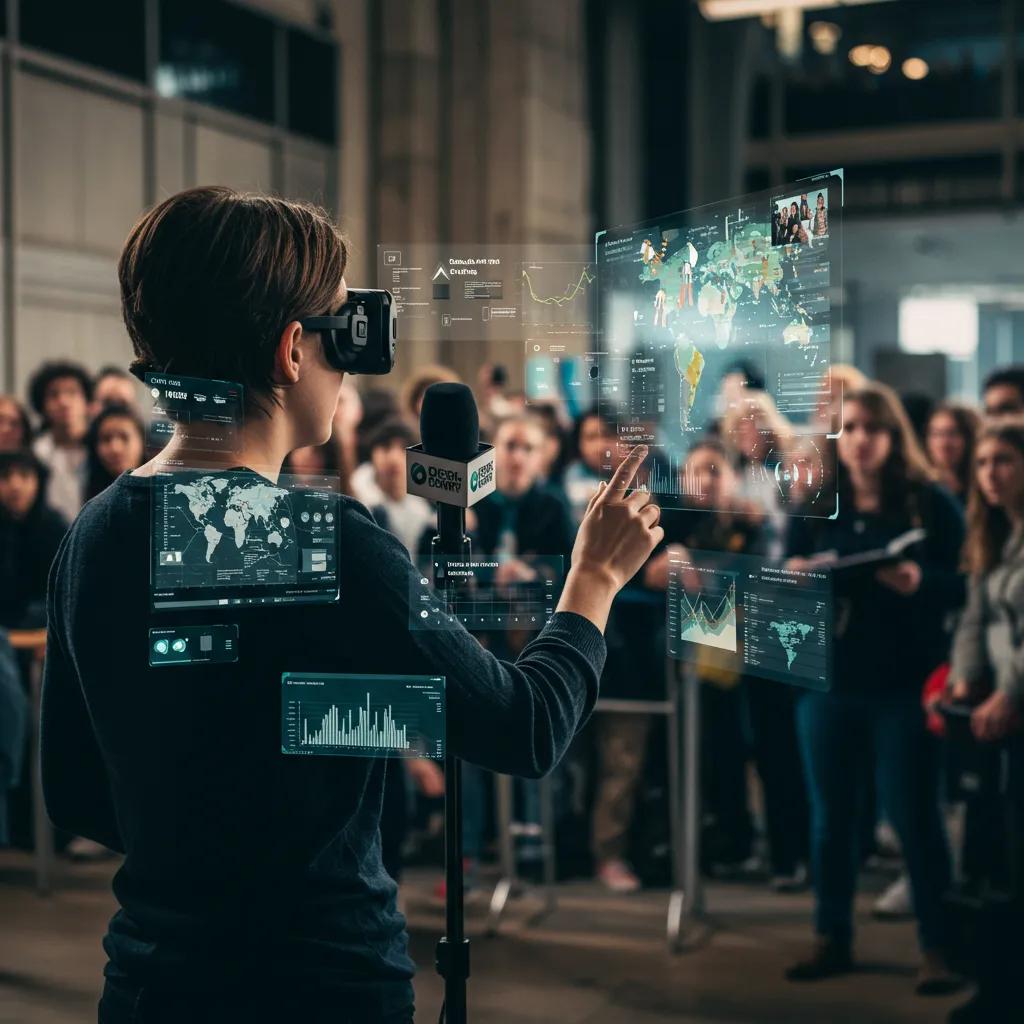
AR is changing journalism by enabling immersive reporting, contextualized data overlays, and interactive explainers that help audiences understand complex issues faster and more intuitively. News organizations can deploy AR to spatialize data, reconstruct scenes for investigative reporting, and create localized, on-the-ground overlays that combine video, live feeds, and fact checks. The core value is richer comprehension: AR increases time-on-story and empathy by turning abstract metrics into tangible, explorable visualizations that readers can manipulate. Practical newsroom integration requires editorial workflows for verification, tagged metadata for provenance, and production templates that scale across reporters and topics. These operational changes equip newsrooms to experiment with AR while maintaining standards for accuracy and transparency.
The integration of AR into journalism is significantly enhancing the way news is presented and consumed.
Augmented Reality Applications in Journalism and News Reporting
The significance of digital storytelling through AR is , the availability of AR on mobile devices, such technologies as broadband wireless .
What Are the Benefits of AR for Immersive Reporting?
AR delivers higher engagement and clearer context by converting abstract information into anchored visual objects and interactive timelines that audiences can explore. This method supports empathy—readers can place themselves in reconstructed environments or view scaled models of infrastructure damage—while maintaining editorial control through labeled overlays and source attribution. For journalists, AR tools streamline explanations of complex datasets, enabling reporters to show geospatial trends, layered timelines, or 3D reconstructions in the field with minimal post-production. These benefits make AR especially useful for beat reporting on climate, urban planning, and conflict zones where spatial relationships matter; newsroom adoption then depends on creating repeatable production patterns and lightweight templates for common story types.
How Does AR Enhance Data Visualization in News?
AR spatializes data by mapping statistics, charts, and geospatial layers onto physical contexts, turning tables and graphs into explorable objects that reveal correlations and patterns more intuitively. Interactive overlays let users toggle variables, animate time-series data, or inspect metadata attached to visual elements, improving comprehension for non-expert audiences. Integration with live data feeds and automated verification pipelines allows AR visuals to reflect changing conditions—such as traffic flows or environmental sensors—while provenance labels and embedded sources maintain trust. This capability transforms conventional static infographics into living, explorable assets that readers can use to interrogate claims and follow up on primary data.
What Are Notable Case Studies of AR in Journalism?
Several media experiments have demonstrated tangible gains from AR: immersive visual explainers boosted engagement for investigative pieces, 3D reconstructions clarified complex incidents, and location-based AR guides increased attendance and awareness for civic reporting efforts. These case studies typically report increases in time-on-story, social sharing, and audience recall when AR elements are used judiciously and paired with clear editorial signals. Lessons for other newsrooms include starting with narrowly scoped pilots, measuring audience metrics tied to comprehension, and building templates that reduce production overhead. Adapting those pilots to local contexts requires attention to device availability and audience platform preferences to ensure accessibility.
Experts in the field recognize the significant potential of augmented reality to shape the future of journalism.
Augmented Reality in Journalism: Possibilities and Future Scenarios
The Gartner Hype Cycle for Emerging Technologieshighlights “augmented human technologies” as one of their emerging trends, while theFuture Today Institutealludes to the potential of extended reality (digitally manipulated environments encompassing virtual and augmented reality) for the development of new applications with great informative value. Based on this, the current study brings together in-depth interviews with experts who analyze the possibilities of augmented reality (AR) in journalism, including its weaknesses and some proposals for new journalistic scenarios.
How Is AI Integrated with AR to Improve News Experiences?

AI enhances AR by performing scene understanding, automated annotation, and personalization that reduce manual overhead for reporters. Computer vision models detect objects and extract semantic labels automatically, while NLP pipelines generate contextual captions, translations, and concise summaries that can be rendered as overlays. Generative AI helps create 3D assets or simulate reconstructions from sparse data, accelerating production for explainer stories. Personalization engines can tailor AR content to user interests or literacy levels, while edge AI inference reduces privacy exposure by processing sensitive data on-device. Together, these AI capabilities speed newsroom workflows and enable richer, localized AR experiences without sacrificing verification or editorial control.
What Are the Latest Augmented Reality Glasses and Devices in 2025?
The 2025 device landscape blends high-end spatial headsets, enterprise smart glasses, and powerful mobile AR platforms that collectively determine where publishers invest for AR storytelling. Leading headsets prioritize high-fidelity passthrough, large content ecosystems, and developer tools for spatial apps, making them suitable for in-depth immersive reports and studio production. Enterprise smart glasses focus on durability, integration with field systems, and remote assistance features for operational deployments. Mobile platforms and WebAR ensure the broadest reach for publishers, enabling quick AR embeds in stories without new hardware.
This comparison shows that mobile AR offers the easiest path to scale, while headsets and enterprise devices enable deeper immersion and operational use cases. Choosing the right device class depends on audience reach and story complexity, which shapes development and editorial investments.
What Features Do Apple Vision Pro and Meta Quest 3 Offer?
High-profile consumer spatial devices typically emphasize spatial computing, accurate passthrough, and ecosystem support to host immersive journalism content. Key features for news use include high-resolution displays for readable overlays, robust spatial audio for narrative immersion, and developer toolchains that support content distribution and cross-device testing. These devices also offer distinct content ecosystems and distribution controls that influence how publishers package and monetize AR stories. For newsroom decision-making, the crucial considerations are content portability, production cost, and the potential audience size reachable via each platform.
How Do Microsoft HoloLens and Magic Leap Compare?
Enterprise-grade devices focus on durability, enterprise SDKs, and integration capabilities that support remote assistance, guided procedures, and collaborative workflows. Differences between enterprise platforms typically center on field deployment tooling, ease of integration with corporate systems, and developer support for enterprise authentication and data pipelines. For newsroom uses that require on-location data overlays or collaboration with experts, enterprise devices offer stable, supportable hardware but introduce higher procurement and integration complexity than consumer or mobile approaches.
What Are Emerging Mobile AR Platforms Like ARKit and ARCore?
Mobile AR SDKs provide core capabilities—plane detection, light estimation, anchor management, and scene understanding—that let developers build spatial overlays within native apps. ARKit and ARCore differ in device-specific optimizations but converge on standard APIs for tracking and rendering, enabling cross-platform development through common engines and frameworks. For newsrooms, these SDKs are the fastest route to deploy interactive explainers and location-based reporting at scale, since they leverage users’ existing smartphones and tablets rather than requiring new hardware purchases.
How Is WebAR Expanding Access to Augmented Reality?
WebAR lowers the barrier to entry by delivering AR experiences through the browser, eliminating the need for native app installation and enabling seamless integration into articles and social channels. The trade-off is limited access to native-device features and reduced performance compared with dedicated SDKs, but modern WebAR frameworks now support practical use cases like product overlays, simple 3D explainers, and lightweight interactive models. For publishers aiming for broad reach and minimal friction, WebAR offers a pragmatic channel to test AR concepts before investing in native apps or headset content.
What Are the Key Market Trends and Growth Drivers in Augmented Reality for 2025?
The AR market in 2025 is driven by AI integration, mobile expansion beyond gaming, and growing enterprise investment in operational efficiency and training. AI improves scene understanding and content generation, enabling new product categories and reducing production costs for immersive content. Mobile platforms continue to expand user bases for AR experiences because they avoid hardware adoption curves, while enterprise ROI from remote assistance and maintenance motivates larger corporate spend. These drivers together push both consumer and enterprise segments toward sustainable growth as developers and publishers refine viable business models for AR.
How Is the Global AR Market Projected to Grow by 2025?
Market projections for 2025 show robust growth in user adoption and platform investment, with mobile AR user bases expanding faster than headset ownership due to device penetration. Headset shipments grow more slowly but attract disproportionate developer attention because of higher per-user engagement and monetization potential for premium immersive content. Forecast variability exists across sources, yet the consensus indicates significant year-over-year increases in AR-enabled application deployments across retail, manufacturing, and media sectors. These projections justify newsroom experiments and enterprise pilots focused on measurable ROI or audience engagement improvements.
This market snapshot highlights that scalable adoption will likely come from mobile-first strategies, while enterprise deployments will fund specialized hardware and workflows that demonstrate measurable operational gains.
What Role Does AI Play in Accelerating AR Adoption?
AI contributes scene understanding, object recognition, and generative content creation that reduce manual asset creation and improve realism in AR experiences. On-device machine learning enables privacy-preserving inference for object detection and contextual overlays, while cloud-assisted models accelerate content personalization and multi-user synchronization. Generative AI tools can produce 3D assets or translate reporting transcripts into concise visual overlays, shortening production timelines for publishers. These capabilities lower the cost of entry and open new editorial possibilities by automating repetitive tasks and enriching interactivity.
How Are Enterprise AR Solutions Transforming Industries?
Enterprise AR improves field service, manufacturing, and healthcare through real-time guidance, remote expert collaboration, and enriched training simulations that reduce error rates and increase productivity. Remote assistance overlays let experts annotate equipment remotely, and stepwise AR-guided procedures reduce onboarding time for technicians. Integration with existing enterprise systems—asset management, CRM, or EHR—delivers measurable ROI when workflows are restructured around AR-assisted tasks. As enterprises pilot these workflows and measure outcomes, AR becomes a justified investment for operational excellence rather than a novelty.
What Is the Impact of Mobile AR Expansion Beyond Gaming?
Mobile AR is broadening commercial use cases from gaming into retail product visualization, AR navigation, and remote support. Retail try-on and product previews improve conversion by letting consumers inspect items in situ, while AR navigation and location-based storytelling add contextual layers to urban reporting and tourism. Remote support apps enable technicians and customers to share visual context and receive guided overlays that speed troubleshooting. For publishers, this trend means mobile-first AR experiences are the most practical avenue to reach broad audiences and integrate AR into everyday news consumption.
What Are the Ethical and Privacy Considerations of Augmented Reality Technology?
AR introduces unique privacy and ethical challenges because of persistent sensing, potential biometric collection, and the persuasive power of overlays that can alter perception. Devices that capture continuous environmental data may collect bystander information, location traces, or personally identifiable features such as faces without consent. Newsrooms and developers must therefore adopt transparency measures, on-device processing, and clear provenance labeling for AR content to maintain public trust. Accessibility and misinformation are additional concerns: AR must be designed inclusively to serve users with diverse abilities, and editorial safeguards are required to prevent manipulative or deceptive overlays that could mislead audiences.
What Privacy Concerns Arise from AR in Media and Daily Use?
AR systems can collect a wide range of personal data—visual imagery of people and places, motion traces, and implicit context about where a user spends time—which amplifies surveillance risks when combined with face recognition or persistent logging. Consent mechanisms, selective data retention, and on-device processing are practical mitigations that reduce exposure by minimizing data sent to the cloud. Transparency about what is collected and why, plus options to disable sensing features, preserves user agency and aligns with ethical reporting standards. Implementing these safeguards helps newsrooms use AR responsibly while protecting sources, subjects, and bystanders.
- Use on-device inference to minimize cloud transfers.
- Implement transparent consent prompts before sensing begins.
- Minimize data retention and anonymize incidental captures.
These precautions reduce risk and support ethical AR deployment in public reporting contexts.
How Does AR Affect Accessibility and Inclusion?
AR can enhance accessibility by offering audio overlays, automated captioning, and on-the-fly translations that help users with sensory or language barriers access content more fully. However, physical form factors, cognitive load from dense overlays, and assumptions about device ownership can exclude users who lack compatible hardware or who are sensitive to visual stimulation. Inclusive design practices—such as adjustable overlay density, alternative text modes, and keyboard/navigation support—ensure AR improves access rather than creating new barriers. Prioritizing these features in early pilots helps broaden audience reach and meets ethical obligations for equitable access.
What Are the Risks of Misinformation Through AR News?
AR overlays could be manipulated to present misleading annotations or fabricated contextual data, enabling persuasive misinformation that leverages perceived realism. To mitigate this, newsrooms must maintain strict provenance practices: every overlay should include source attribution, timestamps, and verification metadata that users can inspect. Editorial guidelines should mandate human review for AR assets used in reporting and require transparent labeling when simulated reconstructions are presented. These safeguards reduce the risk that AR amplifies false narratives and help maintain editorial trust in immersive formats.
How Will Augmented Reality Shape the Future of News and Enterprise Solutions?
AR will reshape storytelling by introducing layered narratives, user-driven exploration, and persistent spatial data that link stories to places and objects over time. For enterprises, AR will drive productivity gains through workflow re-design, training efficiencies, and customer-facing product visualizations that change how services are delivered. Cross-device experiences—where mobile users, headset owners, and browser visitors share consistent AR narratives—will become more feasible as standards and toolchains improve. To realize these futures, organizations must invest in content pipelines, verification practices, and partnerships that align editorial goals with technical capabilities.
What Innovations Are Expected in AR Devices and Applications?
Near-term innovations include improved optics and lighter wearables that reduce fatigue, more powerful on-device AI for scene understanding, and more efficient content-creation tools that generate 3D assets from 2D sources. Battery and thermal improvements will extend usable session lengths, while cloud-assisted rendering will enable richer scenes on lightweight devices through hybrid processing. These hardware and software improvements lower production friction and enable newsroom experiments that combine live reporting with spatial overlays and dynamic data feeds.
How Will AR Continue to Enhance Immersive Storytelling?
AR enables layered narratives in which users explore different facets of a story at their own pace—switching between eyewitness accounts, data layers, and archival materials anchored to locations or objects. This user-driven exploration fosters deeper engagement and allows journalists to present complex stories non-linearly while preserving editorial structure through guided overlays. Integrating live reporting and data feeds ensures stories stay current, and interactive elements invite audiences to test claims, follow sources, and access original datasets, creating a more participatory news ecosystem.
What Emerging Enterprise AR Use Cases Will Drive Adoption?
Enterprise adoption will be driven by field service and maintenance overlays that reduce downtime, remote collaboration tools that replicate expert guidance across geographies, and retail solutions that improve customer conversion through accurate product visualization. These use cases demonstrate direct ROI—faster repair times, reduced travel costs, and higher online-to-offline conversion—and provide clear business cases for AR investment. As these deployments scale, AR platforms will integrate more tightly with enterprise resources, enabling automated analytics and continuous improvement of AR-assisted workflows.
How Can Pakistani Industries and Audiences Benefit from Augmented Reality?
Pakistan and South Asia can harness AR to modernize education, support remote healthcare, and rejuvenate retail through immersive product visualization, while media platforms can use AR to deepen civic engagement and translate complex policy debates into accessible experiences. Infrastructure and device access remain constraints, but targeted pilots—mobile-first and WebAR experiences—can reach younger, digitally active audiences. ARY News, as an information hub and with its positioning around “Ai Reporting Yard,” can pilot AR explainers and election-coverage overlays tailored to Pakistani users, leveraging social distribution to engage the 16–32 demographic that consumes political news heavily on social platforms.
This sector mapping shows clear benefits tempered by adoption barriers such as device penetration, regulatory clarity, and local developer capacity. Addressing those gaps—through partnerships, localized content, and mobile-first pilots—will accelerate practical adoption in Pakistan.
What Are Current AR Developments in Pakistan and South Asia?
Regional activity includes early-stage startups, academic pilots, and isolated industry trials focused on training, retail demos, and education supplements, though coverage is uneven and scalability remains limited. Infrastructure constraints, limited local content ecosystems, and skills gaps in 3D asset production slow progress compared with markets where developer ecosystems and funding are stronger. Nevertheless, the demand for localized language experiences and mobile-first distribution offers a pragmatic path: small-scale, measurable pilots that demonstrate direct impact on learning outcomes or retail metrics can attract investment and partnerships.
How Is AR Being Adopted in Pakistani Education, Healthcare, and Retail?
Practical AR pilots in education can deliver interactive science labs and virtual field trips that reduce the need for physical resources while improving engagement. In healthcare, AR-assisted remote guidance and pre-operative visualizations can support clinicians where specialist availability is limited, provided regulatory and privacy frameworks are addressed. Retailers can deploy mobile AR try-on tools and product visualizers to replicate in-store experiences online, boost conversions, and support e-commerce growth. Each sector benefits from clear pilot objectives, measurement frameworks, and attention to device accessibility through mobile and WebAR channels.
How Can ARY News Leverage AR to Engage Pakistani Audiences?
ARY News can apply AR to editorial and product initiatives aligned with its information hub role and audience profile by launching AR explainers for major national events, embedding WebAR visualizations in election coverage, and producing immersive social-first stories that resonate with younger viewers. Practical ideas include AR-enabled timelines of political developments, location-based overlays for civic reporting, and short AR explainers that summarize complex policy issues for social distribution. These initiatives should prioritize mobile compatibility and transparency, ensuring that overlays include source attribution and verification metadata to maintain trust while expanding audience engagement.
- AR Explainers: Short, mobile AR modules that visualize policy impacts and clarify data.
- Election Coverage Overlays: Location-anchored results and contextual overlays for local constituencies.
- Social-first Immersive Stories: Bite-sized AR experiences optimized for the 16–32 demographic.
Implementing these projects requires small, measurable pilots, cross-functional editorial-technical teams, and a focus on distribution through the platforms where younger audiences consume news. These steps can position ARY News to test the editorial value of AR while maintaining the accuracy and speed central to its mission as an information hub.
Conclusion
Augmented reality is revolutionizing journalism and enterprise by enhancing storytelling, improving data visualization, and fostering deeper audience engagement. By leveraging AR technology, newsrooms can create immersive experiences that clarify complex issues and drive empathy among viewers. As industries in Pakistan explore these innovative applications, the potential for growth and modernization becomes evident. Discover how AR can transform your approach to news and enterprise solutions today.