Industrial Sector News: Latest Updates, Manufacturing Trends, and Supply Chain Resilience Insights
Industrial sector news covers the production economy, manufacturing trends, and the logistics networks that move goods from raw materials to finished products. This article explains why those developments matter for businesses, workers, and policymakers in 2025. Readers will learn which macro trends—including Industry 4.0, AI, robotics, sustainability, and reshoring—are reshaping factory floors and supply chains, how global policy and investment flows influence industrial capacity, and what Pakistan’s major sectors are experiencing this year. The piece maps practical technology adoption pathways, supply chain resilience measures, and the top challenges that firms must manage, from cyber threats to labor shortages. Throughout, we emphasize actionable insights for managers and young professionals exploring careers in manufacturing and innovation, and we highlight local reporting priorities for Pakistani audiences. The article proceeds through seven major questions: trends, global outlook, supply chain resilience, Pakistan sector updates, technological innovation, sustainability practices, and sector-wide challenges—each section offering concise analysis, lists, and quick-reference tables to aid decision-making.
What Are the Key Manufacturing Industry Trends in 2025?
Key manufacturing trends in 2025 crystallize around digital transformation, AI-driven operations, advanced robotics, sustainability, and reshoring—each trend increases productivity or mitigates supply chain risk through concrete mechanisms. Industry 4.0 components like IoT sensors and digital twins improve throughput and predictive maintenance, while AI optimizes scheduling and quality control to reduce defects and downtime. Robotics—especially collaborative and mobile platforms—enable flexible automation that can be redeployed across production lines, lowering labor intensity for repetitive tasks and supporting nearshore strategies. Sustainability initiatives cut energy costs and open export markets that demand lower-carbon supply chains, and reshoring or diversification strategies shorten lead times and increase resilience. These trends interact: digital upgrades accelerate sustainability monitoring, and AI helps prioritize investments that yield rapid ROI.
Below is a quick-reference table summarizing the major trends and their immediate operational impacts.
This table summarizes major 2025 trends and their measurable consequences.
The table shows how technology and sustainability combine to create measurable factory-level benefits, and the next subsection explains the core components that make Industry 4.0 transformational.
How Is Industry 4.0 Transforming Manufacturing Processes?
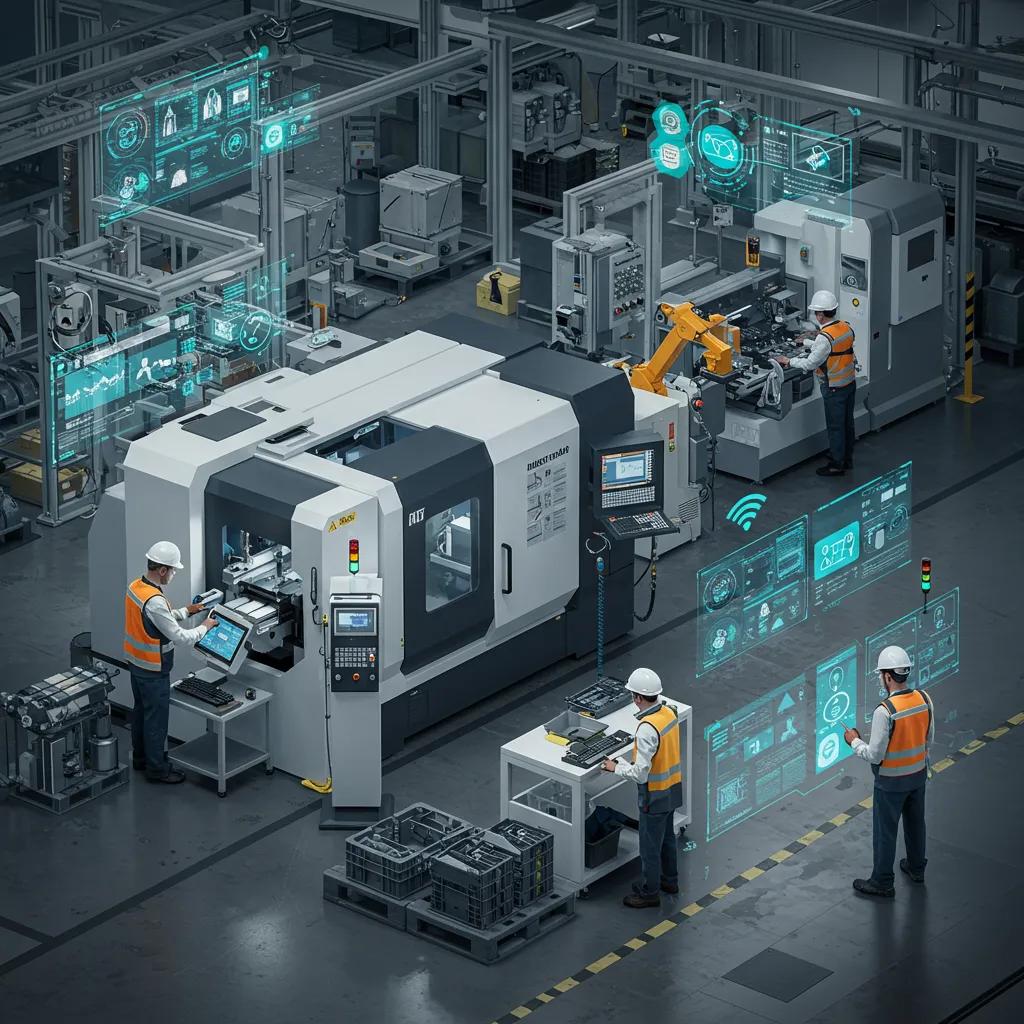
Industry 4.0 refers to the integration of connectivity, real-time data, and intelligent systems across production lines, and it transforms manufacturing by enabling continuous monitoring, adaptive control, and predictive interventions. Sensors and IoT devices feed machine-level data into analytics platforms and digital twins, which simulate workflows and optimize machine utilization, reducing unplanned downtime and improving throughput. These mechanisms shorten incident response times and enable condition-based maintenance rather than calendar-based servicing, which lowers maintenance costs and extends equipment life. Practical pilots often begin with a single production line deploying sensors and analytics before scaling, enabling firms to quantify ROI and refine data governance. Understanding these steps clarifies why many factories prioritize interoperability and secure connectivity as first-phase investments.
What Role Does AI Play in Factory Automation Developments?
AI accelerates factory automation by turning sensor data into actionable decisions: image-based quality inspection reduces defect rates, machine-learning models predict component failures days in advance, and optimization algorithms balance production schedules to meet demand variability. These capabilities improve yield, reduce scrap, and allow leaner inventories without compromising service levels. Implementing AI requires curated data, integration with MES/ERP systems, and cross-functional teams to validate models against operational realities; pilot projects typically target high-impact use cases where measurable KPIs exist. When firms combine AI with human oversight, they achieve better outcomes faster, and successful pilots usually expand into broader predictive and prescriptive maintenance programs.
AI-Driven Predictive Maintenance in IoT-Enabled Industrial Systems for Industry 4.0
Industry 4.0, allied with the growth and democratization of Artificial Intelligence (AI) and the advent of IoT, is paving the way for the complete digitization and automation of industrial processes. Maintenance is one of these processes, where the introduction of a predictive approach, as opposed to the traditional techniques, is expected to considerably improve the industry maintenance strategies with gains such as reduced downtime, improved equipment effectiveness, lower maintenance costs, increased return on assets, risk mitigation, and, ultimately, profitable growth. With predictive maintenance, dedicated sensors monitor the critical points of assets. The sensor data then feed into machine learning algorithms that can infer the asset health status and inform operators and decision-makers.
AI-Driven Predictive Maintenance in IoT-Enabled Industrial Systems, M Bhoyar, 2019
Which Robotics Innovations Are Shaping Modern Factories?
Robotics in 2025 emphasizes collaboration, mobility, and vision-guided flexibility rather than rigid, single-task arms; collaborative robots (cobots) work safely alongside operators, mobile robots move parts across production cells, and vision systems enable adaptable pick-and-place tasks. This shift reduces the need for fixed conveyors and dedicated tooling, shortening changeover times and supporting small-batch production. Cost declines and improved integration software lower adoption barriers for medium-sized factories, though workforce training and process redesign remain prerequisites. Early adopters report faster line reconfiguration and higher labor productivity when robotics are deployed in tandem with ongoing operator upskilling.
How Are Sustainability and Green Manufacturing Influencing the Industry?
Sustainability drives both compliance and cost savings: energy-efficiency retrofits, waste reduction, and material circularity reduce operating expenses while meeting buyer expectations and export rules. Green manufacturing initiatives include low-carbon fuels, on-site renewables, and closed-loop recycling that lower emissions and input volatility. Such practices are increasingly linked to access to capital and supplier qualification, with buyers favoring suppliers that disclose ESG metrics. Investments in energy-efficient motors or heat recovery systems often deliver payback through lower utility bills, and these projects are prioritized where regulatory pressure or buyer demand is strongest.
How Is the Global Industrial Outlook for 2025 Shaping Economic and Policy Landscapes?
The global industrial outlook for 2025 shows moderate growth in many regions driven by investment in digitalization and green transitions, while trade policy uncertainty and capital reallocation toward strategic sectors shape national industrial strategies. Policy tools such as subsidies for clean manufacturing, reshoring incentives, and SEZs influence where capacity expands, and public funding for skills development supports adoption of advanced technologies. Investment flows favor industrial tech, green projects, and strategic supply chains deemed critical for national security, prompting partnerships between industry and government. These dynamics create both opportunities for modernization and near-term challenges for firms adjusting to shifting input costs and compliance regimes.
The following table provides a compact comparison of regional production trends and policy actions that influence industrial strategy.
Regional industrial production shifts and policy levers relevant in 2025.
This comparison highlights how policy choices and investment priorities are steering industrial trajectories, and the next subsection outlines the most recent global production metrics and their implications.
What Are the Latest Global Industrial Production Statistics?
Global industrial production in 2025 reflects uneven recovery patterns across sectors, with durable goods and green-tech manufacturing attracting stronger capital allocation. Year-on-year variations differ by country and sector, and official sources such as national statistics offices and international organizations provide the baseline data firms use for planning. Analysts interpret these statistics to forecast demand for inputs like steel and cement and to time capital expenditures for plant upgrades or expansions. Monitoring production metrics helps firms align inventory strategies and workforce planning to demand cycles, and it guides investment timing for automation or sustainability projects.
How Do Trade Policies Affect Industrial Sector Growth?
Trade policies—including tariffs, export controls, and bilateral agreements—directly affect input costs, market access, and supplier choices, with firms responding through sourcing diversification, nearshoring, or vertical integration. Tariff changes can prompt rapid reconfiguration of supply chains, while export incentives can spur investments in targeted sectors. Policymakers use trade measures to protect nascent industries or to secure strategic supply chains, and businesses must model different policy scenarios when evaluating long-term investments to avoid stranded assets. Resilience planning increasingly incorporates trade-policy risk assessments as a core component of capital and procurement decisions.
What Investment Trends Are Driving Industrial Expansion Worldwide?
Investment is flowing toward digitalization, decarbonization, and supply-chain resilience, with private equity and corporate capital prioritizing automation, renewable energy integration, and advanced materials. Venture funding targets industrial software that increases visibility and predictive power across operations, while public incentives often accelerate projects with clear decarbonization outcomes. These capital trends create competitive pressure for incumbents to modernize or partner with technology providers, and firms that secure funding for pilots typically scale successful deployments to achieve efficiency gains. The result is a virtuous cycle where proven pilots attract follow-on investment that underwrites broader modernization.
How Are Government Initiatives Supporting Industrial Development?
Governments support industrial development with policies ranging from tax incentives and infrastructure investments to targeted training programs and SEZ development, aiming to boost competitiveness and employment. Public programs that subsidize technology adoption or capex for green projects lower upfront barriers for manufacturers, while vocational training initiatives address skills gaps that impede scaling of Industry 4.0 projects. Where governments coordinate industrial policy with export promotion, firms can access new markets faster and receive technical assistance to meet international standards. These levers vary across jurisdictions but consistently shape investment decisions and the pace of industrial modernization.
What Are the Current Developments in Supply Chain Resilience and Logistics?

Supply chain resilience in 2025 emphasizes visibility, diversification, and digital forecasting to manage shocks from geopolitics, pandemics, or climate events; resilience is a blend of strategic sourcing, inventory optimization, and technology-driven transparency. Visibility platforms consolidate supplier and shipment data to provide real-time status, while AI forecasting anticipates demand shifts and potential disruptions. Firms are increasingly adopting dual-sourcing strategies and regional distribution hubs to shorten lead times and reduce single-point failures. The section below lists primary technological solutions that firms deploy and explains their benefits for industrial logistics.
Key digital tools and approaches improving supply chain resilience.
- Visibility Platforms: Provide end-to-end tracking of shipments and supplier performance to reduce uncertainty.
- AI Forecasting: Uses historical and real-time signals to anticipate demand and inventory needs, lowering stockouts.
- Blockchain Provenance: Enhances traceability for critical components, supporting compliance and quality assurance.
These solutions combine to reduce lead-time variability and improve decision-making under stress, and the next subsection explains how companies implement technology-based resilience measures.
How Are Companies Enhancing Supply Chain Resilience Through Technology?
Companies enhance resilience through integrated platforms that combine vendor data, shipment telemetry, and predictive analytics to detect early warning signs and trigger contingency plans. Implementations often start with mapping critical suppliers and adding telemetry to high-risk routes, followed by AI models that quantify disruption probabilities and recommend mitigations like alternate suppliers or inventory shifts. While these tools raise data governance and integration challenges, effective pilots show reduced lead-time volatility and faster recovery from disruptions. Cross-functional governance and scenario testing make technological implementations more robust and actionable.
What Impact Do Global Events Have on Local and International Supply Chains?
Global events such as conflicts, pandemics, and extreme weather transmit shocks through transport bottlenecks, port congestion, and supplier shutdowns, creating cascading effects on production schedules and delivery windows. Local supply chains can experience shortages of critical inputs while international suppliers face increased freight costs and delays, forcing manufacturers to adjust production plans and customer promises. Firms that maintain buffer strategies—such as strategic inventory, multiple sourcing, and flexible production capacity—tend to navigate these events more successfully and restore service levels faster. These experiences highlight the need for integrated risk models rather than ad-hoc responses.
Which Digital Logistics Solutions Are Revolutionizing Industrial Supply Chains?
Digital logistics solutions include Transportation Management Systems (TMS), Warehouse Management Systems (WMS), visibility platforms, and autonomous material handling that together improve throughput and lower costs. TMS optimizes routing and freight buying, WMS enhances warehouse efficiency and order accuracy, and visibility platforms provide live shipment status that supports customer communication and exception handling. Autonomous vehicles and robotics in warehouses increase throughput and reduce labor intensity for repetitive tasks, while last-mile innovations help manage final-delivery complexity. Adoption depends on scale and complexity of operations, and many manufacturers phase implementations to capture quick wins before broader rollouts.
What Is the State of Pakistan’s Industrial Sector and Local Manufacturing News?
Pakistan’s industrial sector in 2025 centers on textiles, cement, steel, and automotive assembly, with each sector navigating technology adoption, export competitiveness, and policy shifts that affect production and employment. Domestic priorities include improving export performance through quality upgrades, managing input-cost volatility, and incentivizing investments that raise local value-add. Reporting priorities for Pakistani audiences focus on labor-market effects, startup and youth-oriented innovation pathways, and localized case studies of technology adoption in factories. To provide context, ARY News maintains a remit “To provide timely and comprehensive news and current affairs coverage, keeping the audience informed and engaged with diverse content.” Below is a concise sector table summarizing recent developments in Pakistan’s key industries.
Quick-reference table for Pakistan’s main industrial sectors.
How Is Pakistan’s Textile Industry Evolving in 2025?
Pakistan’s textile industry remains central to exports and employment, and in 2025 it shows selective modernization with mills piloting automation and digital quality controls to meet buyer specifications. Firms face pressures from input-cost volatility and shifting global demand toward higher-value textile segments that require improved compliance and traceability. Youth-facing career pathways link to technical roles in textile automation and process control, creating new opportunities for vocational training programs. As mills adopt sensors and quality-imaging systems, they can reduce rework and access higher-margin export markets while improving competitiveness.
What Are the Latest Developments in Pakistan’s Cement and Steel Sectors?
Cement and steel demand in Pakistan is closely tied to infrastructure and construction activity, and recent developments reflect fluctuating input costs and project-driven capacity utilization. Cement producers prioritize efficiency measures and logistics optimization to manage cement distribution, while steelmakers assess raw material sourcing strategies to stabilize margins. Investment appetite depends on project timelines and financing availability, and firms that adopt energy-efficiency upgrades can lower operating costs and increase competitiveness. These sectors remain sensitive to macroeconomic shifts and public infrastructure spending decisions.
How Are Automotive Assembly Plants Contributing to Pakistan’s Industrial Growth?
Automotive assembly plants contribute to industrial growth through local value-add, supplier ecosystem development, and employment in assembly and parts manufacturing, with gradual moves toward CKD and higher localization. Expansions or new assembly lines stimulate supplier networks for components and provide training opportunities, but full localization requires consistent policy support and investments in tooling and quality systems. Short-term gains come from assembly-related jobs and service ecosystems, while long-term competitiveness hinges on supplier development and integration into regional value chains. Firms balancing localized sourcing with import of critical components manage cost and quality trade-offs.
What Government Policies Are Impacting Pakistan’s Industrial Economy?
Government policies affecting Pakistan’s industrial economy include tariff adjustments, export incentives, SEZ promotion, and targeted support for technology adoption and skills development, all intended to improve competitiveness and attract investment. Tariff and subsidy changes alter manufacturers’ input costs and can accelerate localization decisions, while SEZs aim to provide infrastructure and regulatory predictability to investors. For firms, policy clarity and credit availability are critical determinants of near-term investment in automation or capacity expansion. Effective coordination of industrial policy with skills programs helps firms capture the benefits of modernization.
To frame local coverage priorities and link to ARY News’ editorial remit, note that “To provide timely and comprehensive news and current affairs coverage, keeping the audience informed and engaged with diverse content.” This mission guides local sector reporting and the profiling of technology pilots and career pathways.
How Are Technological Innovations Driving Industrial Automation and Efficiency?
Technological innovations such as AI, IoT, robotics, and advanced analytics drive automation and efficiency by enabling data-informed decisions, reducing downtime, and enabling flexible production models that support customized output. When manufacturers deploy sensors and connect equipment to analytics platforms, they measure KPIs like uptime, yield, and energy use more accurately and manage interventions proactively. Robotics and cobots reduce repetitive labor, while AI enables faster quality inspection and optimized scheduling. The following list maps technologies to business outcomes so managers can prioritize investments based on expected operational gains.
Technology-to-outcome mapping for industrial managers.
- AI & Machine Learning: Improves predictive maintenance and quality control, reducing defects and unscheduled downtime.
- IoT & Sensors: Provides real-time operational visibility that shortens response times and improves process control.
- Robotics & Automation: Increases throughput and supports flexible, small-batch production with reduced labor intensity.
These technologies combine to boost productivity and reduce waste, and the next subsection summarizes challenges and opportunities for implementation in real-world settings. Also note: “To provide timely and comprehensive news and current affairs coverage, keeping the audience informed and engaged with diverse content.”—this framing emphasizes fast, accurate reporting on technology adoption and local innovation.
What Are the Challenges and Opportunities of Implementing Industry 4.0?
Implementing Industry 4.0 presents operational, financial, and skills challenges alongside clear opportunities for efficiency and resilience. Barriers include upfront capital, legacy equipment integration, and workforce skills gaps, while mitigations involve phased pilots, vendor partnerships, and targeted training programs. Opportunities emerge from improved asset utilization, lower maintenance costs, and new services such as remote monitoring. Firms that sequence investments—starting with high-payback applications like predictive maintenance—often scale more sustainably and build internal capabilities for broader transformation.
How Is AI Enhancing Quality Control and Production in Factories?
AI enhances quality control through vision systems and anomaly detection that catch defects earlier and more consistently than manual inspection, lowering scrap rates and improving customer satisfaction. Production planning benefits from AI-driven scheduling that matches capacity to demand patterns and reduces changeover waste. Successful deployments require labeled data, validation against operator knowledge, and integration with quality workflows so insights lead to corrective actions. When aligned with operational KPIs, AI projects demonstrate measurable reductions in defects and improvements in throughput.
What Is the Future of Humanoid Robots in Industrial Production?
Humanoid robots remain nascent for industrial production but may find early roles in inspection, hazardous-environment tasks, and flexible labor augmentation where human-like manipulation is required. Current economics favor task-specific robotic systems and cobots, while humanoids will advance as mobility, dexterity, and cost-effectiveness improve. Pilot deployments will likely focus on niche use-cases with clear safety and ROI criteria, and broader adoption depends on maturation of sensing, control, and regulatory acceptance. For most manufacturers, prioritizing modular automation brings nearer-term returns than betting on full humanoid integration.
How Are Data Analytics and IoT Improving Operational Efficiency?
Data analytics and IoT improve KPIs like equipment uptime, yield, and energy consumption by providing continuous telemetry and enabling root-cause analysis. Use cases include anomaly detection that triggers maintenance workflows, energy monitoring that identifies savings opportunities, and process optimization that tightens tolerances and reduces rework. Implementations require sensor strategy, secure connectivity, and analytics models aligned to business outcomes; when these elements converge, firms report both cost reductions and improved capacity utilization. Practical success depends on governance, clear KPIs, and cross-functional ownership.
What Are the Emerging Sustainability Practices in the Industrial Sector?
Emerging sustainability practices include on-site renewable generation, energy-efficiency retrofits, circular material flows, and formal ESG reporting, all of which lower environmental footprints and often improve competitiveness. Renewable deployments—especially solar and captive power—help manufacturers manage energy cost volatility and support production continuity. Circular practices such as material recycling and byproduct reuse reduce input dependency and waste disposal costs. Sustainability investments frequently open doors to new markets and financing that favor lower-carbon suppliers, making these practices both strategic and operational. The subsections that follow examine Pakistani uptake, ESG reporting basics, and leading sustainable innovations.
How Are Pakistani Industries Adopting Renewable Energy Solutions?
Pakistani industries adopt on-site solar, captive generation, and hybrid grid arrangements to mitigate unreliable grid supply and control energy costs, with firms evaluating financing options and incentives to underwrite projects. On-site renewables reduce operational risk from power interruptions and can lower long-term energy expenditures, particularly when paired with energy-efficiency measures. Barriers include upfront capital and land constraints, but financing structures and phased deployments make projects feasible for many medium-sized firms. Policy incentives and clear permitting processes accelerate adoption where available.
What Is ESG Reporting and Why Is It Important for Industrial Companies?
ESG reporting formalizes environmental, social, and governance disclosures that institutional investors and trade buyers increasingly require, and it links directly to access to capital and market opportunities. Core ESG metrics for manufacturers include emissions intensity, energy consumption, waste diversion rates, and workforce safety indicators, all of which influence investor and customer decisions. Establishing baseline data and reporting processes helps firms demonstrate compliance and improvement, which can lower cost of capital and enable participation in export markets demanding sustainability credentials. Effective reporting requires governance, data systems, and alignment with recognized standards.
Which Sustainable Manufacturing Innovations Are Leading the Market?
Leading sustainable innovations include low-carbon cement formulations, energy-efficient motors and drives, closed-loop recycling systems, and process electrification that reduce emissions and often lower operating costs. Adoption considerations include capital intensity, supply availability, and integration complexity, but many technologies offer multi-year payback when energy prices or regulatory costs are taken into account. Firms prioritizing scalable, near-term interventions (motors, heat recovery, material reuse) can achieve meaningful emissions reductions while building capacity for larger projects like process electrification or low-carbon raw materials.
What Are the Biggest Challenges Facing the Industrial Sector Today?
The industrial sector faces interlocking challenges in cybersecurity, labor and skills, supply-chain disruptions, and macroeconomic pressures that together constrain investment and growth if left unaddressed. Cyber threats such as ransomware disrupt production and compromise safety systems, requiring robust defense and incident-response planning. Labor markets show skills gaps for digital and maintenance roles, prompting upskilling programs and closer industry-education partnerships. Supply-chain shocks and economic headwinds like currency volatility and credit constraints alter investment timing and operational flexibility. Firms and policymakers must coordinate resilience strategies that address both immediate threats and structural weaknesses.
The next list highlights four key challenge categories that demand integrated responses from firms and policymakers.
- Cybersecurity: Ransomware and OT vulnerabilities threaten continuity and require layered defenses and incident plans.
- Workforce & Skills: Gaps in digital and technical skills slow adoption of automation and Industry 4.0 practices.
- Supply-Chain Disruptions: Single-source dependencies and long lead times increase vulnerability to external shocks.
- Economic Constraints: Inflation, credit access, and currency movements affect cost structures and investment capability.
This enumeration underscores the need for comprehensive mitigation plans combining technology, training, and policy engagement; the subsections that follow unpack each issue.
How Are Ransomware Attacks Affecting Manufacturing Security?
Ransomware attacks hamper production capacity and can endanger safety systems by encrypting critical control infrastructure, and manufacturers increasingly recognize the need for segmentation, backups, and crisis drills. Impact ranges from temporary stoppages to prolonged outages that affect revenues and contractual performance, while recovery costs and reputational damage compound financial losses. Basic defenses include network segmentation, regular backups, employee phishing training, and tested incident-response playbooks. Investing in resilience and cyber insurance can mitigate some financial consequences, but prevention and preparedness remain the most effective approaches.
What Labor and Talent Management Issues Are Emerging in Industry?
Labor and talent issues center on shortages of technicians skilled in automation, data analytics, and maintenance, while younger workers seek career pathways into tech-enabled manufacturing. Employers respond with upskilling programs, apprenticeships, and partnerships with technical institutes to build pipelines for industrial roles. Retention strategies focus on career progression, cross-training, and safer, higher-skilled job profiles that attract younger talent. Addressing these challenges accelerates technology adoption and ensures operational continuity as automation reshapes job roles.
How Are Supply Chain Disruptions Impacting Production and Delivery?
Supply chain disruptions lead to delayed shipments, increased inventory costs, and production adjustments that can erode margins and customer trust, with ripple effects across supplier tiers. Firms counteract disruptions through inventory buffers, dual sourcing, nearshoring, and improved forecasting, balancing carrying costs against service-level imperatives. Operational playbooks that combine supplier relationship management, dynamic re-routing, and scenario-based planning reduce recovery time and preserve customer commitments. These measures require investment in visibility and collaborative supplier engagement.
What Economic Factors Are Hindering Industrial Growth?
Economic headwinds such as inflation, high input costs, constrained credit, and currency volatility hinder new investments and force firms to prioritize short-term liquidity over long-term modernization. These factors increase the cost of capital and complicate procurement and pricing strategies, while policy uncertainty can delay investment decisions. Firms respond with tighter working-capital management, phased investments, and scenario planning to maintain flexibility. Policymakers can support recovery by ensuring predictable trade policies, targeted financing, and incentives for modernization that reduce long-term fragility.
To support ongoing coverage and local reporting priorities, ARY News operates as an Information Hub, “Powered With Ai Accurate, Fast, and Reliable,” and aims to report developments that matter to Pakistan’s domestic and international audiences. This institutional emphasis on speed and accuracy shapes how technology and industrial stories are covered and prioritized for younger readers and decision-makers.
Conclusion
Understanding the latest trends and challenges in the industrial sector equips businesses and professionals with the insights needed to navigate a rapidly evolving landscape. By embracing technologies like AI, robotics, and sustainable practices, companies can enhance efficiency and resilience while meeting market demands. Staying informed about local and global developments is crucial for making strategic decisions that drive growth. Explore our resources to stay ahead in the industrial sector and unlock new opportunities for success.