Quantum Computing Explained: Applications, Challenges, and Future Breakthroughs
Quantum computing uses quantum-mechanical phenomena—primarily superposition and entanglement—to process information in ways that classical computers cannot, offering potential speedups for specific problem classes. This article explains what quantum computing is, how qubits and quantum gates form circuits, and why algorithms like Shor’s and Grover’s matter for real-world tasks. Readers will learn current applications in AI, cryptography, healthcare, and finance, the major engineering and workforce challenges that constrain progress, and the near-term breakthroughs to watch in 2025 and beyond. The piece also localizes the story for Pakistan by outlining likely industry impacts, ethical considerations, and practical learning pathways for young people. Throughout, we integrate regional context and timely reporting perspectives to help readers connect global advances to local opportunities in education, policy, and industry development.
What Is Quantum Computing and How Does It Work?
Quantum computing is a model of computation that encodes information in quantum bits (qubits) which exploit superposition and entanglement to represent and process many states simultaneously. The mechanism works by preparing qubits in controlled quantum states, applying sequences of quantum gates to create interference patterns that amplify correct answers and measuring the system to extract results. The specific benefit is the potential to solve certain optimization, simulation, and number-theoretic problems far more efficiently than classical machines, for example accelerating molecular simulations or certain cryptanalytic tasks. Understanding these fundamentals makes it easier to evaluate near-term experiments and the realistic timelines for achieving useful quantum advantage in applied domains.
ARY News provides timely, accessible explanations of complex scientific topics and ongoing breakthroughs, helping readers follow developments in quantum computing as they unfold. This editorial role supports Pakistani and international readers who want clear, localized context for why a new quantum milestone matters and what it could mean for regional technology strategies. For continuous coverage and contextual updates on quantum breakthroughs, ARY News aims to provide reporting that connects technical progress to policy, education, and industry implications in Pakistan.
What Are Qubits and Why Are They Important?
Qubits are the fundamental units of quantum information, analogous to classical bits but able to exist in superpositions of 0 and 1, enabling parallel exploration of multiple computational paths. Physically, qubits appear in several modalities—superconducting circuits, trapped ions, photonic systems, and neutral atoms—each with trade-offs in coherence time, control speed, and engineering complexity. The importance of qubits lies in coherence and fidelity: longer coherence times and higher gate fidelities permit deeper circuits and more complex algorithms before errors overwhelm results. Advances in qubit quality directly translate to practical capability, so tracking physical implementations and error metrics is essential for assessing progress toward fault-tolerant quantum computing.
How Do Quantum Superposition and Entanglement Enable Computing?
Superposition allows a qubit to represent a weighted combination of 0 and 1, which means multi-qubit systems can encode an exponentially large state space relative to classical bits; entanglement binds qubits so measurements are correlated in ways impossible classically. Together, these effects let quantum algorithms explore many candidate solutions simultaneously and use interference to amplify correct solutions while canceling incorrect ones. A clear example is how entangled states enable quantum teleportation of information and form the basis of distributed quantum protocols. Despite these advantages, decoherence and error accumulation limit algorithm depth, so practical gains often rely on hybrid quantum-classical workflows in the near term.
NISQ Era Hybrid Quantum-Classical Machine Learning: A Survey
Quantum computing is a rapidly growing field that has received a significant amount of support in the past decade in industry and academia. Several physical quantum computers are now freely available to use through cloud services, with some implementations supporting upwards of hundreds of qubits. These advances mark the beginning of the noisy intermediate-scale quantum (NISQ) era of quantum computing, paving the way for hybrid quantum-classical (HQC) systems. This work provides an introductory overview of gate-model quantum computing through the Visual IoT/Robotics Programming Language Environ- ment and a survey of recent applications of NISQ era quantum computers to HQC machine learning.
A survey of NISQ era hybrid quantum-classical machine learning research, G De Luca, 2022
What Are Quantum Gates and Circuits?
Quantum gates are reversible operations that transform qubit states; typical single- and two-qubit gates include the Hadamard, Pauli-X, and CNOT, which together form universal sets for quantum computation. Quantum circuits assemble these gates into sequences that prepare inputs, perform computation through controlled interference, and conclude with measurements that collapse quantum states into classical outputs. The practical benefit of circuits is flexible algorithm design: by composing gates in different patterns, engineers implement algorithms for chemistry simulation, optimization, and search. Compared with classical logic gates, quantum gates must preserve coherence and often require precise timing and low-noise control systems, making hardware and control electronics critical constraints.
How Does Quantum Computing Differ from Classical Computing?
Quantum computing differs from classical computing primarily in how information is represented and manipulated: classical bits are deterministic 0s or 1s, while qubits leverage superposition and entanglement to explore multiple states concurrently. This difference yields potential exponential state-space advantages for some problems but comes with practical limits such as noise sensitivity, error rates, and the need for quantum error correction to reach fault tolerance. In realistic near-term systems (NISQ devices), quantum processors provide heuristic or domain-specific benefits through hybrid algorithms rather than general-purpose speedups. Understanding this contrast helps set accurate expectations for where quantum technology will provide value first, such as specialized simulations and optimization tasks rather than replacing classical infrastructure.
This comparison highlights the trade-offs between speed, coherence, and engineering complexity across qubit modalities and explains why different companies pursue distinct hardware approaches.
What Are the Key Applications of Quantum Computing Today?
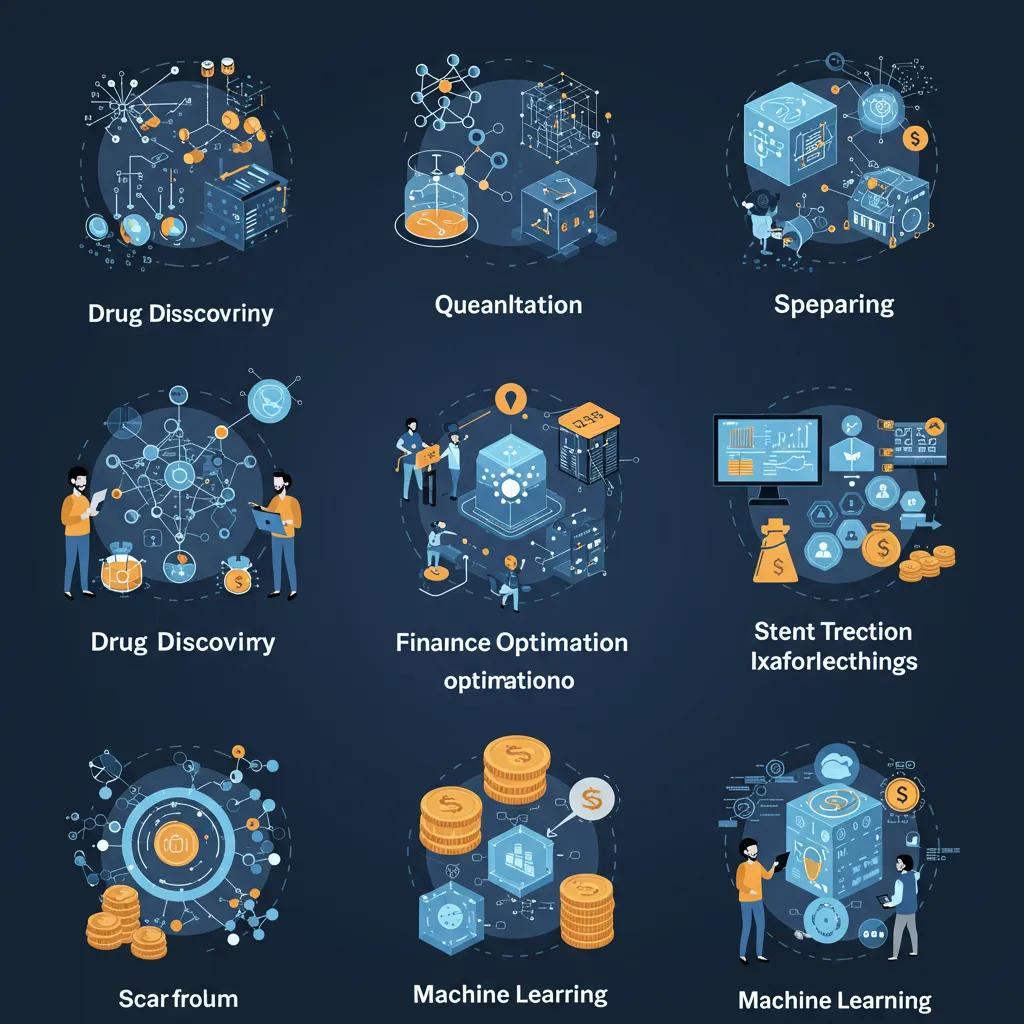
Quantum computing today focuses on application domains where quantum properties provide new capabilities: molecular simulation for drug discovery, optimization for logistics and finance, improved sampling for machine learning, and cryptographic considerations that drive post-quantum defenses. These applications deliver value either by enabling more accurate simulations of quantum systems or by accelerating specialized mathematical subroutines; the benefit in each domain depends on algorithm maturity, available qubit counts, and integration with classical systems. Near-term pilots and hybrid architectures are the dominant path to industry impact, and comparing domains clarifies where organizations should invest in experiments now versus preparing for longer-term capabilities.
Quantum computing supports these key domains in practical ways:
- Drug discovery and materials: simulate molecular interactions that are intractable for classical methods to speed candidate identification.
- Optimization and finance: improve portfolio optimization, derivative pricing, and supply-chain logistics with specialized solvers.
- Machine learning: augment classical models with quantum-enhanced sampling and kernel methods for feature discovery.
- Cryptography and security: motivate migration to post-quantum cryptography while enabling new secure communication primitives.
This table clarifies where quantum computing produces practical value today and helps decision-makers prioritize pilot investments.
How Is Quantum Computing Revolutionizing Artificial Intelligence and Machine Learning?
Hybrid quantum-classical systems pair quantum subroutines with classical models to accelerate optimization, sampling, and feature mapping tasks in machine learning workflows. Current approaches use quantum processors for specific kernels or variational circuits while offloading bulk computation to classical hardware, which reduces risk and leverages strengths of both platforms. The practical benefit is targeted speedups or improved solution quality for select model training tasks, but limitations remain: small qubit counts, noise, and integration complexity constrain scalable deployments. Ongoing research and cloud-accessible SDKs are lowering the barrier for ML practitioners to experiment with quantum-enhanced pipelines.
Hybrid Quantum-Classical Machine Learning Models for AI Advancement
The burgeoning field of machine learning has transformed numerous sectors, revolutionizing everything from image recognition to financial forecasting. However, classical machine learning algorithms often encounter limitations when dealing with complex, high-dimensional problems. This is where the nascent field of quantum machine learning (QML) emerges, offering a paradigm shift with its unique computational capabilities. By harnessing the principles of quantum mechanics, QML promises to solve problems intractable for classical methods, like simulating complex molecules or optimizing financial portfolios. However, current quantum hardware limitations necessitate a hybrid approach:Hybrid Quantum-Classical Machine Learning Models (HQCLML).The convergence of quantum computing and classical machine learning has sparked significant interest in the development of hybrid quantum-classical machine learning models. This research explores the synergy between quantum and classical paradigm
Hybrid quantum-classical machine learning models: powering the future of AI, MR Pulicharla, 2023
What Role Does Quantum Computing Play in Cybersecurity and Cryptography?
Quantum computing threatens certain public-key cryptosystems by offering algorithms that factor large integers or solve discrete logarithms exponentially faster, necessitating the adoption of post-quantum cryptography to preserve long-term confidentiality. The mitigation strategy is proactive migration toward quantum-resistant algorithms and hybrid encryption schemes while monitoring progress in fault-tolerant quantum hardware. Organizations should inventory critical systems, prioritize cryptographic agility, and begin testing post-quantum solutions to ensure data remains secure against future quantum-capable adversaries.
How Is Quantum Technology Transforming Drug Discovery and Healthcare?
Quantum-assisted molecular simulation can model electronic structures and reaction dynamics with higher fidelity than classical approximations, lowering the time and cost of lead optimization in drug discovery. Early pilots combine quantum subroutines with classical chemistry packages to evaluate binding affinities and reaction pathways, demonstrating potential for accelerated candidate selection. Practical timelines depend on improvements in qubit counts and error rates; near-term benefits are incremental but meaningful for complex molecular systems where classical methods struggle.
Quantum Computing’s Transformative Role in Genomic Medicine
Quantum computing offers unprecedented computational power by exploiting quantum mechanical phenomena such as superposition and entanglement. Genomic medicine, the field concerned with using genomic information for diagnosis, treatment, and prevention of disease, is increasingly data intensive, with vast datasets, complex pattern recognition tasks, and computationally expensive algorithms. This article explores how quantum computing can transform genomic medicine by accelerating sequence alignment, improving variant calling, enabling efficient drug discovery, and facilitating personalized therapy design. While potential breakthroughs abound, there are challenges: quantum hardware limitations, error rates, ethical and privacy implications, and integration into existing healthcare systems. We propose a multidisciplinary framework that unites physics, computer science, and healthcare to realize these potentials. The article concludes with recommended research directions, po
Quantum Computing and Genomic Medicine: Bridging Physics, Computer Science, and Healthcare, 2025
What Are the Benefits of Quantum Computing in Finance and Optimization?
Quantum approaches offer improved heuristics for combinatorial optimization, enabling better routing, scheduling, and portfolio decisions under complex constraints. Financial institutions explore quantum-inspired algorithms and hybrid solvers to achieve incremental performance gains in risk modeling and derivative pricing. While end-to-end production systems remain distant, pilot projects show potential cost savings and improved decision quality in constrained optimization problems.
Which Companies Are Leading Quantum Computing Innovations in 2025?
Major technology and specialized companies lead innovation through hardware breakthroughs, software ecosystems, and cloud access that democratizes experimentation. Industry leaders focus on different hyponyms of quantum hardware—superconducting processors, trapped-ion platforms, photonic systems—and invest heavily in SDKs and developer tooling to attract a broader user base. Understanding each company’s 2025 highlight clarifies where resources are advancing toward logical qubits, improved error rates, and practical software integrations that support enterprise pilots.
What Are IBM’s Latest Quantum Computing Breakthroughs?
IBM continues to emphasize scalable superconducting architectures and a robust software ecosystem to make quantum resources accessible to researchers and enterprises. Their focus on processor connectivity, calibration improvements, and tooling supports broader experimentation and algorithm development. For developers, the ecosystem benefit is cloud-based access and established SDKs that lower the barrier to entry, helping industry teams prototype use-cases that integrate quantum subroutines.
How Is Google Advancing Quantum Supremacy and Hardware?
Google’s hardware research targets chip-level innovations that reduce error rates and improve qubit coherence and interconnectivity, aiming to demonstrate clear performance milestones on targeted problem instances. These engineering advances inform the broader research community about realistic pathways to quantum advantage and help refine benchmarks that align hardware progress with application readiness. The translation from laboratory milestones to industry uptake requires software and error-correction progress alongside hardware improvements.
What Innovations Are Microsoft and Quantinuum Bringing to Logical Qubits?
Microsoft and Quantinuum prioritize approaches toward logical qubits and error correction, demonstrating early experiments that map pathways to fault-tolerant operation. Their work emphasizes software-hardware co-design and error-suppression techniques that reduce resource overheads for logical encodings. Progress toward logical qubits is critical because it signals when quantum systems can run deeper algorithms reliably, shifting the focus from transient NISQ gains to sustained, general-purpose quantum computation.
Which Emerging Companies Are Shaping the Quantum Industry?
A cohort of startups focuses on niche modalities—photonic processors, diamond-based sensors, and quantum control software—adding specialization to the quantum ecosystem and accelerating application-specific solutions. These companies attract investor interest by targeting near-term commercial use-cases and by partnering with research institutions for validation. Tracking these players helps identify where complementary innovations may enable broader adoption beyond the largest incumbents.
What Are the Major Challenges Facing Quantum Computing Development?
Quantum computing development faces technical challenges like decoherence, high error rates, and scalability issues, as well as non-technical barriers such as workforce shortages and supply-chain complexity. Overcoming these problems requires coordinated advances in materials, cryogenics, control electronics, error-correction schemes, and education pipelines. Addressing these challenges will determine the pace at which quantum systems move from laboratory demonstrations to commercially useful deployments across industries.
List of primary technical and non-technical challenges:
- Decoherence and fidelity limitations that restrict circuit depth and algorithm complexity.
- Large resource overheads for error correction needed for fault tolerance.
- Engineering bottlenecks in cryogenics, manufacturing, and control systems for scale.
- Talent shortage and interdisciplinary training gaps slowing adoption and innovation.
A clear mitigation strategy combines incremental hardware improvements, algorithmic error mitigation, workforce development, and public-private partnerships to accelerate practical timelines.
Why Is Qubit Decoherence a Critical Issue?
Decoherence occurs when qubits lose their quantum phase relationships due to interactions with their environment, collapsing superpositions and corrupting computations. Physically, sources include thermal noise, electromagnetic interference, and material defects that reduce coherence times and increase gate error rates. The consequence is limited circuit depth: algorithms requiring many sequential gates become unreliable unless error correction is applied. Improving coherence is therefore a central engineering priority to enable deeper, more useful quantum computations.
How Does Quantum Error Correction Work?
Quantum error correction encodes logical qubits across many physical qubits using structured codes like the surface code to detect and correct errors without directly measuring quantum information. The basic idea is redundancy plus syndrome measurement to identify errors while preserving encoded states. Trade-offs are steep: resource overheads can require hundreds to thousands of physical qubits per logical qubit, making near-term fault tolerance expensive. Recent demonstrations show progress in small-scale codes, but widespread fault tolerance awaits reductions in physical error rates and more efficient codes.
What Are the Scalability and Hardware Development Challenges?
Scaling quantum processors requires advances in qubit manufacturing, packaging, cryogenic infrastructure, and classical control electronics that can handle large arrays of qubits with low latency. Interconnects, thermal management, and calibration complexity grow quickly with qubit count, demanding modular and networked approaches to system design. Approaches such as modular quantum nodes, photonic interconnects, and distributed quantum computing architectures are active research pathways to address these engineering bottlenecks.
Why Is There a Shortage of Skilled Quantum Computing Talent?
The field demands interdisciplinary skills—quantum physics, control engineering, software development, and domain expertise—creating a steep learning curve and high demand for trained practitioners. Academic programs, bootcamps, and industry training help, but capacity expansion is needed to meet industry hiring needs. For Pakistan, targeted scholarships, university-industry partnerships, and accessible online resources can accelerate workforce development and create pathways for young engineers and scientists.
What Are the Future Trends and Breakthroughs in Quantum Computing for 2025 and Beyond?
Near-term trends to watch include demonstrations of logical qubits, tighter hybrid quantum-AI integration, advances in room-temperature or diamond-based quantum systems, and the scaling of quantum networks for secure communications. Market growth will track with hardware reliability and software ecosystems that enable industrial pilots; investment will likely concentrate on middleware, error mitigation, and application-focused startups. Following these trends helps policymakers and industry leaders prioritize areas where early investments can yield strategic advantage.
Key trends to monitor:
- Progress toward logical qubits and demonstrable error-corrected operations.
- Hybrid quantum-AI systems that combine quantum subroutines with classical learning frameworks.
- Diamond-based and other room-temperature platforms that reduce cryogenic overhead.
- Development of quantum networks and QKD for secure communications.
How Will Hybrid Quantum-AI Systems Impact Technology?
Hybrid quantum-AI systems embed quantum subroutines within classical machine-learning pipelines to tackle optimization and sampling bottlenecks, potentially improving model search and training efficiency. Practical impact includes faster hyperparameter searches, improved probabilistic sampling for generative models, and domain-specific accelerations where quantum primitives map naturally to the problem structure. Widespread impact depends on developer tools, accessible SDKs, and empirical demonstrations of end-to-end gains in real workflows.
What Is the Significance of Diamond-Based Quantum Systems?
Diamond-based systems, relying on nitrogen-vacancy centers, promise longer coherence times at or near room temperature and strong sensing capabilities, which could reduce the need for extensive cryogenics and enable new sensor and communication applications. Their benefits include robustness and integration potential, while challenges relate to fabrication consistency and scaling to many qubits. If matured, diamond approaches could diversify hardware options and enable niche applications in sensing and network nodes.
How Are Quantum Networks Changing Data Security and Transfer?
Quantum networks enable quantum key distribution (QKD) and entanglement distribution that can secure communication channels in fundamentally new ways, providing mechanisms for tamper-evident links and future-resistant keying methods. Practical network architectures combine quantum repeaters and trusted nodes to extend range, with pilot deployments demonstrating city-scale links. Implications for cybersecurity include new secure channels and a complementary role to post-quantum cryptography for end-to-end protection strategies.
What Are the Expected Market Growth and Investment Trends?
Investment in quantum technologies is shifting toward applied software, middleware, and sector-specific pilots, while venture capital backs startups with clear commercialization paths in sensing, simulation, and niche hardware. Market growth in 2025 is driven by increased cloud access to quantum resources and corporate pilots, with public funding supporting foundational research and workforce initiatives. Policymakers should align incentives and education investments to capture economic opportunities while managing geopolitical and security implications.
How Does Quantum Computing Impact Society and Pakistan’s Technology Sector?
Quantum computing raises societal questions about privacy, inequality, and national competitiveness while offering economic opportunities for industries that adopt early pilots, such as finance, pharmaceuticals, and logistics. For Pakistan, the local impact depends on education pipelines, public research support, and industry partnerships that translate global breakthroughs into regional applications. Addressing ethical implications and workforce readiness will determine whether quantum technology widens gaps or creates inclusive growth through targeted policy and investment.
What Are the Ethical and Societal Implications of Quantum Technology?
Quantum technology can exacerbate surveillance capabilities, shift geopolitical power balances, and create inequality if access concentrates among well-resourced actors, raising privacy and governance concerns. Policy frameworks should address data longevity, dual-use risks, and equitable access to emerging benefits. Transparent public dialogue and cross-sector governance are necessary to balance innovation with civil liberties and societal resilience.
How Could Quantum Computing Influence Pakistan’s Economy and Industries?
Quantum-enabled optimization and simulation could improve supply chains, energy distribution, and pharmaceutical research in Pakistan, delivering economic efficiencies and enabling higher-value services. Realizing these gains requires targeted R&D funding, university-industry collaborations, and pilot programs that demonstrate local ROI. Barriers include infrastructure, access to expertise, and capital, so phased strategies combining capacity building and pilot demonstrations are recommended.
Who Are the Pakistani Scientists and Tech Leaders in Quantum Computing?
Pakistan’s growing academic and research community includes university groups and individual researchers contributing to foundational quantum science and engineering; potential collaboration targets include local physics departments and technology institutes. Strengthening visibility of these leaders through interviews, fellowships, and joint projects can accelerate knowledge transfer and inspire students. Building networks with international research centers enhances local capacity and opens pathways for joint innovation.
How Can Young People Learn and Engage with Quantum Computing?
Young learners should focus on foundational skills—linear algebra, quantum mechanics basics, and programming—while experimenting with cloud-based quantum SDKs and online courses to build practical experience. Recommended pathways include MOOCs, open-source toolkits, and participation in hackathons or research internships to gain applied skills. Local initiatives, university programs, and industry internships can provide mentorship and project opportunities that translate academic knowledge into practical capabilities.
Learning resources to begin quantum pathways:
- Enroll in foundational math and physics courses to build theoretical grounding.
- Practice with quantum SDKs and toy problems to develop coding and algorithmic intuition.
- Seek internships, research projects, and community meetups to gain practical experience.
These steps create a practical roadmap for young professionals to enter quantum-related careers and help build the interdisciplinary workforce Pakistan will need.
What Are the Most Common Questions About Quantum Computing?
This final section addresses frequent public questions concisely, offering clear definitions, concise mechanisms, and actionable recommendations for organizations and individuals assessing quantum risk and opportunity. The answers below are optimized for clarity and quick reference to guide further reading and local engagement.
What Is Quantum Computing in Simple Terms?
Quantum computing uses qubits—which can exist in multiple states simultaneously—and entanglement to process many possibilities at once, enabling efficient solutions to certain problems classical computers find hard. This approach is useful for specialized tasks like molecular simulation and optimization, and its practical impact grows as qubit quality and error correction improve. For learners, the key takeaway is that quantum computing complements, rather than replaces, classical computing for most everyday tasks.
How Does a Quantum Computer Work?
A quantum computation typically follows three steps: prepare qubits in initial quantum states, apply a sequence of quantum gates to create interference patterns that encode the solution, and measure the qubits to obtain classical results. Measurement collapses superpositions, so algorithm design focuses on amplifying correct outcomes before measurement. This workflow underlies algorithms for simulation, search, and factorization, and explains why hardware fidelity and circuit depth limit current capabilities.
What Are the Applications of Quantum Computing?
- Drug Discovery: Simulates molecular interactions to accelerate lead optimization.
- Optimization: Improves logistics, routing, and financial models for better decisions.
- Machine Learning: Enhances sampling and feature discovery in hybrid workflows.
- Cryptography: Drives migration to post-quantum cryptography to protect data.
- Sensing & Networks: Enables advanced sensors and secure quantum communication.
These applications vary in readiness; organizations should pilot where hybrid approaches yield measurable improvements.
What Are the Challenges of Quantum Computing?
- Decoherence and high error rates that limit algorithm depth.
- Large resource overheads for effective error correction.
- Engineering bottlenecks in scaling hardware and control systems.
- A shortage of interdisciplinary talent to design and deploy systems.
Addressing these requires coordinated investment in research, education, and infrastructure to turn laboratory progress into commercial impact.
Is Quantum Computing a Threat to Cybersecurity?
Quantum computing poses a long-term threat to certain public-key cryptosystems because algorithms exist that can break widely used encryption if run on sufficiently large, fault-tolerant quantum computers. The pragmatic response is to adopt post-quantum cryptography standards and build cryptographic agility while monitoring hardware progress. Organizations should assess sensitive data lifetimes and prioritize migration where long-term confidentiality is essential.
This article aims to equip readers with a foundational yet practical understanding of quantum computing, its current applications, and the steps Pakistan and individuals can take to prepare. ARY News remains committed to providing timely and comprehensive news and current affairs coverage, keeping the audience informed and engaged with diverse content.
Conclusion
Quantum computing represents a transformative leap in technology, offering unprecedented capabilities in fields such as drug discovery, finance, and machine learning. By harnessing the unique properties of qubits, organizations can unlock new efficiencies and insights that were previously unattainable with classical computing. As the landscape evolves, staying informed and engaged with these advancements is crucial for leveraging their potential. Explore our resources to deepen your understanding and prepare for the quantum future.