Stanford Researchers Develop AI Model That Predicts Pandemics

Stanford AI Pandemic Prediction Model: How Researchers Develop AI to Forecast and Prevent Pandemics
The Stanford Institute for Human-Centered Artificial Intelligence (HAI) has created a pandemic prediction model that analyzes vast, heterogeneous datasets to forecast disease outbreaks before they escalate. By integrating mobility patterns, genomic information, and environmental signals, this AI model delivers early warnings and actionable insights for public health agencies.
This article explains:
- What the Stanford AI model is and how it works, including data sources, deep learning architectures, and validation methods
- How AI enhances disease surveillance, resource allocation, and health equity
- The ethical safeguards, regulatory context, and societal implications of AI-driven forecasting
- Comparative strengths of Stanford’s approach versus other leading models
- Emerging trends in global collaboration, technology innovation, and practical steps for integration into public health systems
What Is the Stanford AI Model for Pandemic Prediction and How Does It Work?
The Stanford AI model for pandemic prediction combines machine learning and epidemiological expertise to identify outbreak signals days or weeks before conventional methods detect them. By fusing neural-network pattern recognition with public health domain knowledge, it transforms raw data into forecasts that guide prevention strategies and policy decisions.
Which Data Sources Does Stanford’s AI Use for Pandemic Forecasting?
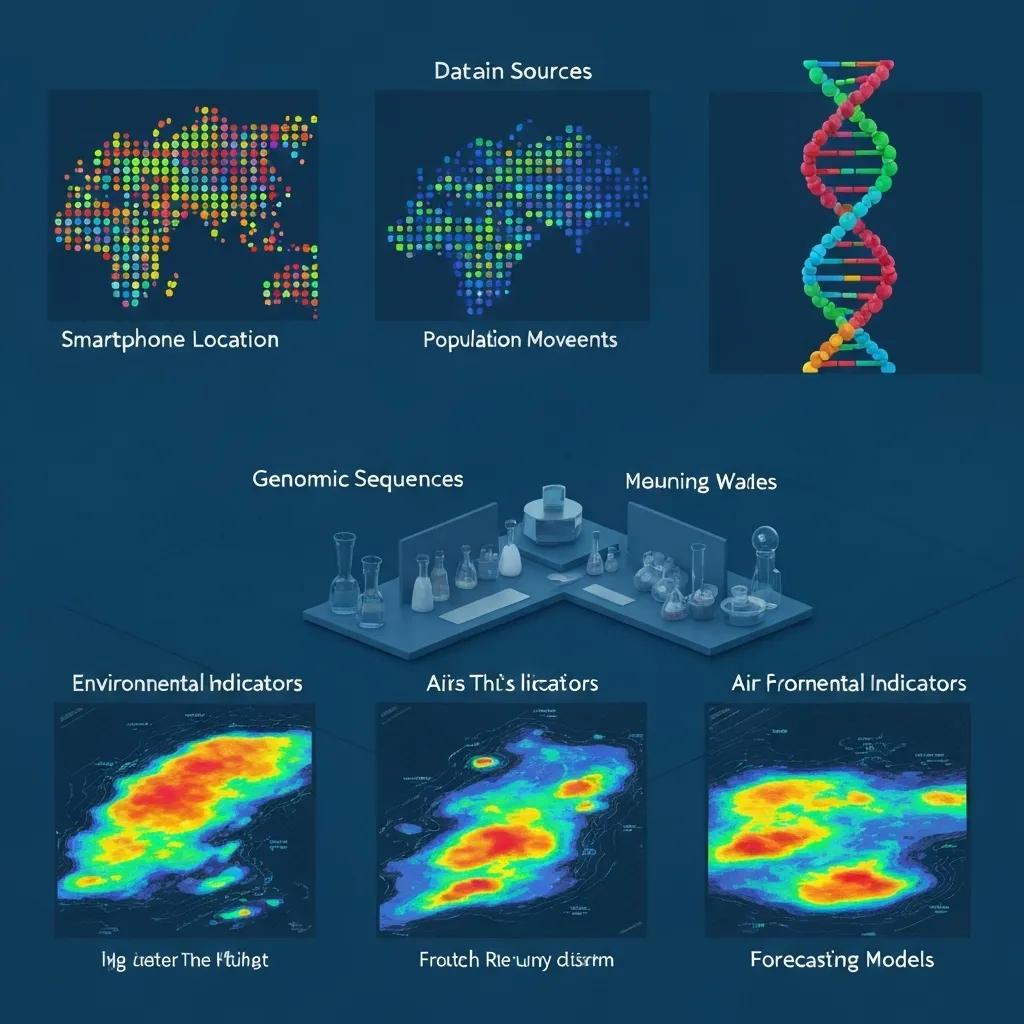
Stanford’s model processes three core categories of data to capture the precursors of disease spread:
- Mobility Data: Aggregated anonymized flows from smartphone location records reveal population movement trends.
- Genomic Sequences: Viral genome databases track mutations and emergence of new variants.
- Environmental Indicators: Climate metrics (temperature, humidity), land-use changes, and wildlife reservoir mapping highlight zoonotic spillover risks.
A unified data pipeline aligns these feeds by timestamp and geography to generate high-resolution risk maps and feature vectors for the learning algorithms. Next, these inputs fuel distinct neural architectures optimized for temporal, spatial, and molecular pattern recognition.
How Do Deep Learning Architectures Enable Virus Spread Prediction?
Stanford’s framework employs a hybrid of convolutional, recurrent, and transformer networks to extract complementary insights:
- Convolutional Neural Networks (CNNs) analyze spatial patterns in mobility heatmaps and satellite imagery to detect hotspots.
- Recurrent Neural Networks (RNNs) and Long Short-Term Memory (LSTM) units capture temporal dependencies in case counts and mobility sequences.
- Transformer Models leverage attention mechanisms to integrate genomic mutation trajectories with global travel networks.
These architectures learn latent representations of outbreak dynamics, allowing the model to forecast case trajectories, reproductive numbers, and variant transmissibility with nuanced precision.
How Is the AI Model Validated for Accuracy in Predicting Pandemics?
Stanford validates its forecasting system via back-testing against historical outbreaks and real-time field trials:
These results demonstrate reliable early warning capabilities across multiple pathogens. Having confirmed high sensitivity and specificity, researchers continuously retrain the model with emerging data to maintain accuracy.
How Does AI Improve Public Health and Epidemiology in Pandemic Prevention?
AI-driven analytics empower health authorities to detect, monitor, and intervene faster than ever before. By automating surveillance and forecasting, public health experts can allocate resources proactively and craft evidence-based policies.
What Role Does AI Play in Early Warning Systems and Disease Surveillance?
AI enhances surveillance through automated anomaly detection in case reports, syndromic data, and social media signals. A continuous monitoring pipeline flags unusual clusters or trends that warrant epidemiological investigation. This rapid detection shortens the response cycle and mitigates outbreak amplification.
How Does AI Support Resource Allocation and Policy Making During Outbreaks?
Predictive models guide allocation of medical supplies, hospital beds, and vaccination campaigns by forecasting demand at the county and state levels. Optimization algorithms recommend shipment routes and staffing levels, reducing bottlenecks and ensuring equitable distribution of critical resources.
How Can AI Address Global Health Equity and Disparities?
By incorporating socioeconomic indicators and health access metrics, AI identifies underserved communities at higher risk of disease spread. Decision support dashboards highlight disparity hotspots, enabling targeted outreach, mobile clinics, and culturally tailored interventions that promote equitable health outcomes.
What Are the Ethical Considerations and Challenges of Using AI for Pandemic Prediction?

Deploying AI in public health raises complex questions around data privacy, bias, and public trust. Stanford’s project embeds rigorous safeguards and transparency to uphold ethical standards while maximizing social benefit.
How Does Stanford Address Data Privacy and Algorithmic Bias in Its AI Models?
Stanford enforces strict de-identification protocols and federated learning to train models without centralizing sensitive personal data. Bias audits evaluate model outputs across demographic groups, with fairness constraints ensuring that predictions do not disproportionately disadvantage any population.
What Regulatory Frameworks Govern AI Use in Public Health?
AI in epidemiology operates under existing health data governance, such as HIPAA and GDPR, alongside emerging AI-specific guidelines from bodies like the WHO and national health authorities. Compliance checks and ethical review boards oversee deployment in clinical and public health settings.
What Are the Societal Implications of AI-Driven Pandemic Forecasting?
While AI promises earlier alerts and data-driven policies, reliance on algorithmic forecasts necessitates public communication strategies that build trust. Transparent model explanations and stakeholder engagement are essential to prevent misinformation and ensure community cooperation.
How Does Stanford’s AI Model Compare to Other Leading Pandemic Prediction Models?
In comparative analysis, Stanford’s integrated, multimodal approach offers distinct advantages in data fusion and adaptability. Other institutions may focus on single data streams or specific pathogens, whereas Stanford’s platform generalizes across diverse disease scenarios.
What Are the Key Differences Between Stanford’s Model and MIT’s VaxSeer?
Stanford’s solution merges mobility, genomic, and environmental inputs for holistic forecasting, while VaxSeer centers on vaccine strain selection by analyzing influenza hemagglutinin sequences. As a result, Stanford’s model provides broader outbreak risk maps, whereas VaxSeer excels in guiding vaccine composition.
How Does Washington State University’s Viral Reservoir Model Complement Stanford’s Approach?
Washington State’s model maps animal-to-human transmission hotspots using ecological data, extending surveillance into wildlife reservoirs. Integrating these reservoir risk scores with Stanford’s mobility-based forecasts strengthens early detection of zoonotic spillovers in high-risk regions.
What Is the Future Outlook for AI in Global Health and Pandemic Prevention?
Advancements in federated learning, protein language models, and cross-border data platforms are poised to revolutionize the global health security ecosystem. Collaborative networks will accelerate innovation and ensure readiness for emerging threats.
Which Emerging AI Technologies Will Shape Pandemic Prediction?
- Federated Learning: Enables multi-institutional model training without sharing raw data, enhancing privacy and model generalization.
- Large Protein Language Models: Decode viral evolution and predict antigenicity shifts for vaccine design.
- Advanced Analytics: Real-time ensemble forecasting and adaptive simulations that adjust to policy interventions.
These innovations promise faster, more accurate, and ethically sound forecasting pipelines.
How Will Global Collaboration Enhance AI-Driven Pandemic Preparedness?
International data-sharing consortia and interoperable AI frameworks will standardize epidemiological reporting and model evaluation. Shared repositories of anonymized health records, genomic sequences, and mobility patterns accelerate collective response capabilities.
What Market Trends and Growth Projections Support AI in Healthcare?
The AI in healthcare market is projected to exceed $100 billion by 2030, growing at a CAGR of 38%. Investments in predictive analytics and epidemiological modeling are a key driver, reflecting global demand for technology that safeguards public health and reduces economic disruption.
What Are the Practical Steps for Implementing AI Models in Public Health Systems?
Translating research prototypes into operational tools requires clear governance, technical infrastructure, and capacity building. A phased deployment strategy ensures sustainable integration and continuous improvement.
How Can Public Health Organizations Integrate Stanford’s AI Model?
Organizations should establish:
- Data-sharing agreements with technology partners and mobile providers
- Secure cloud or edge computing environments for model deployment
- Training programs for epidemiologists and data scientists
These steps lay the foundation for seamless ingestion, analysis, and interpretation of model outputs.
What Policy Recommendations Support Effective AI Deployment?
Policymakers should prioritize funding for open-source AI platforms, mandate equitable data governance, and create cross-sector task forces that align health, technology, and regulatory stakeholders. This ecosystem fosters accountability and innovation.
How Does AI Improve Real-Time Decision Making During Outbreaks?
By delivering dynamic dashboards with scenario projections and intervention impact assessments, AI empowers decision-makers to test “what-if” strategies and adjust measures—such as lockdown timing or vaccine distribution—on the fly, minimizing morbidity and mortality.
Stanford’s AI model represents a paradigm shift in pandemic preparedness, merging advanced algorithms with public health expertise to forecast and forestall disease threats. Ongoing research, ethical stewardship, and international partnerships will expand this predictive capability, ensuring that communities worldwide are better equipped to prevent future pandemics.